Skip to content
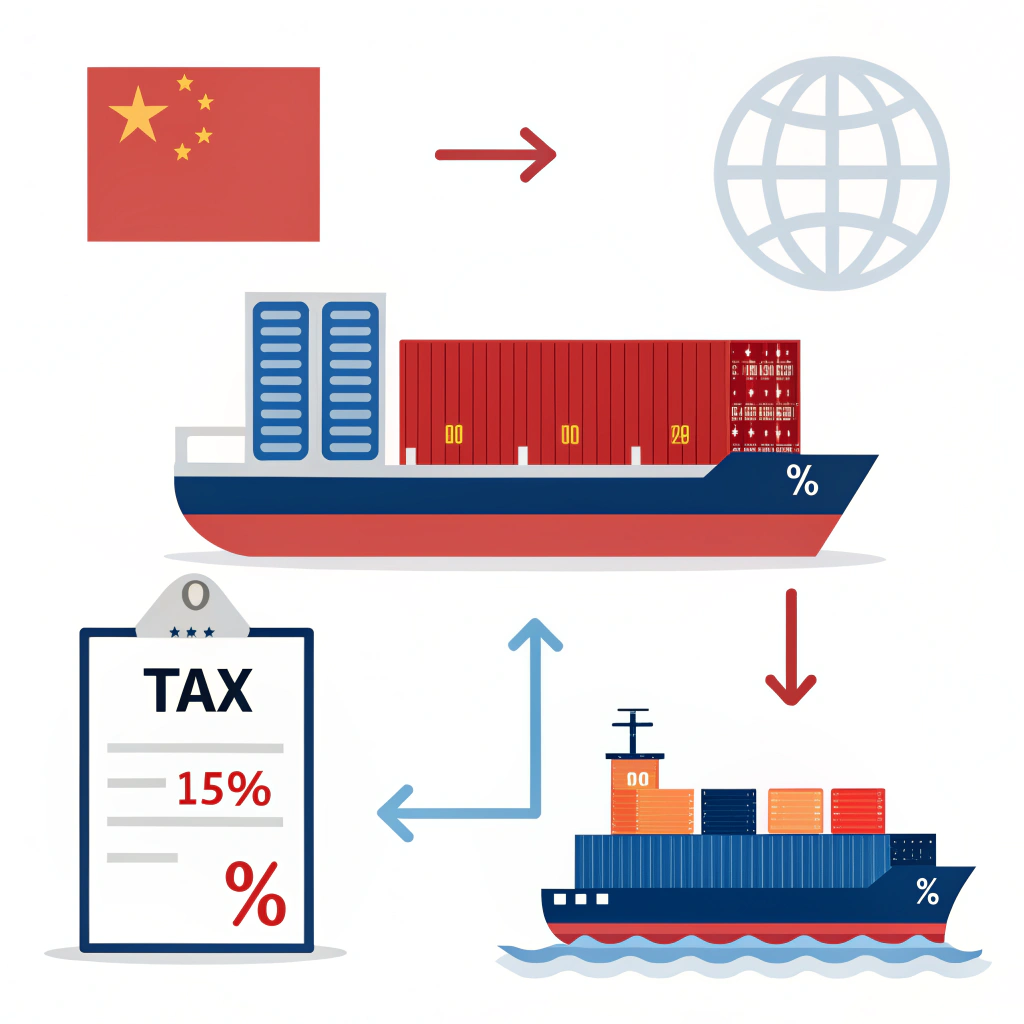
Short answer: There isn’t a single “tariff to ship from China to the US.” Your US import duty depends on the product’s HTSUS1 classification (base duty rate), plus any China-specific measures like Section 3012 (often 7.5% or 25%) and any anti-dumping/countervailing duties (case-specific). Duty is calculated on the customs value of the goods (generally the FOB price), not on your international freight. Most ocean entries also pay Harbor Maintenance Fee (0.125%) and all formal entries pay Merchandise Processing Fee (0.3464%, with annual min/max).
What “tariff” really means for China→US shipping
- Tariff is the US import duty you pay when the goods enter the US. It’s separate from your freight cost.
- Your total landed cost includes duties, trade remedies (e.g., Section 301), fees (MPF/HMF), brokerage charges, delivery, and inland transportation.
- The only way to know your tariff is to classify your product under the Harmonized Tariff Schedule of the United States (HTSUS) and apply any applicable trade remedies.

How to find your duty rate (step-by-step)
-
Define the product precisely
- What is it made of?
- What does it do? How is it used?
- Is it part/accessory of another product?
- Is it assembled, unfinished, or a kit?
-
Classify under HTSUS
-
Check China trade remedies
- Section 301: Many goods of China are subject to additional duties via Chapter 99 (subheadings 9903.88.xx). Common rates: 25% (Lists 1–3) or 7.5% (List 4A). Some product-specific exclusions exist and change over time.
- Anti-dumping/countervailing duties (AD/CVD): If your product is within a specific case scope, additional duties apply by producer/exporter and can be high. Search the International Trade Administration and CBP messages for your product and supplier.
-
Determine customs value and fees
- Valuation: For ad valorem duty, US Customs typically uses the “transaction value” (price paid). For imports from China, this is usually the FOB value at the port of export. If your invoice is CIF4, your broker will back out freight/insurance to arrive at the dutiable value.
- Fees: MPF (0.3464% of entered value, with minimum and maximum that CBP updates annually) and HMF (0.125% of entered value for ocean modes only).
-
Confirm other regulatory flags
- Partner Government Agency (PGA) requirements (FDA, FCC, CPSC, EPA, USDA, etc.)
- Quotas, licensing, trademarks
- Country of origin marking rules
What goes into your landed cost (and what doesn’t)
- Dutiable components (typical):
- Base HTSUS duty rate applied to dutiable value
- Section 301 (if applicable), applied to dutiable value
- AD/CVD (if applicable), per case instructions
- Non-dutiable, but payable:
- MPF: 0.3464% of entered value (formal entries), with CBP-set min/max each fiscal year
- HMF: 0.125% of entered value for ocean shipments
- Brokerage fees, ISF filing fees, bonds, port/terminal charges, delivery
- Not included in ad valorem duty:
- International freight and insurance from China to the US (for ad valorem rates)
- Domestic US distribution costs after entry
Table: Landed cost components and how they’re calculated
| Component | Applies to | Formula/Typical Rate | Notes |
|---|---|---|---|
| Base Duty | All dutiable goods | HTSUS rate × dutiable (FOB) value | Rate depends on HTSUS 10-digit code |
| Section 301 | Many China-origin goods | 7.5% or 25% × dutiable value | Check Chapter 99 subheading 9903.88.xx |
| AD/CVD | Only if case applies | Case rate × dutiable value or quantity | Producer/exporter-specific; can be high |
| MPF | Most formal entries | 0.3464% × entered value (min/max apply) | Updated annually by CBP |
| HMF | Ocean shipments only | 0.125% × entered value | Not for air/express |
| Brokerage | Entry service | Flat fee or tiered | Varies by broker and complexity |
| Bond | Formal entries | Annual or single; set on duties/fees | Continuous bond commonly $50,000+ |
| Inland delivery | Post-clearance | Market rate | Not part of duty |
Does freight change your duty amount?
- For ad valorem duty, no. The US dutiable value is generally the FOB price paid to the seller (plus any assists, packing, royalties, etc.). Ocean/air freight and insurance to the US are excluded from the ad valorem base.
- If your commercial terms are CIF, your broker will deduct freight/insurance (supported by documentation) to arrive at the FOB-equivalent customs value.
- For specific duties (e.g., $/kg), freight does not change the duty; weight/quantity does.
- MPF/HMF are based on entered value, not on freight.
Table: Valuation inclusions vs. exclusions (ad valorem)
| Item | Included in dutiable value? | Notes |
|---|---|---|
| Price paid for goods | Yes | Basis of transaction value |
| International freight to US | No | Deduct from CIF to get FOB-equivalent |
| Insurance to US | No | Deduct like freight |
| Packing costs | Yes | If paid by buyer |
| Assists (molds, tooling) | Yes | Must be added if provided free/at reduced cost |
| Selling commissions | Yes | Buying commissions generally excluded |
| Royalties/license fees | Often yes | If a condition of sale for US export |
What about de minimis (Section 321)?
- The de minimis threshold is $800 per shipment per person per day. Most Section 321 shipments do not pay duty, MPF, or HMF.
- Exclusions: Goods subject to AD/CVD and some regulated items cannot enter under Section 321.
- Business importers using de minimis should still manage compliance (accurate values, proper descriptions, and admissibility).
How Section 301 works in practice
- Identify your HTSUS code. Then check if the code triggers a Chapter 99 subheading 9903.88.xx for China.
- If yes, you will owe the additional rate (often 25% or 7.5%) unless a valid product exclusion applies.
- Exclusions are time-limited and product-specific; documentation must match the exclusion scope exactly.
- Section 301 applies in addition to the base duty rate and before MPF/HMF.
What AD/CVD can mean for your cost
- AD/CVD are trade remedy duties applied when specific products from certain countries are sold at less than fair value or benefit from subsidies.
- Key points:
- They are not universal; they apply only to products and exporters named in specific cases.
- Rates are producer/exporter-specific and can exceed 100%.
- You pay cash deposits at entry. Final assessed duties can be adjusted after administrative reviews.
- Always verify with your supplier whether their product is within any AD/CVD scope and identify the exact producer/exporter for accurate rates.
Worked examples (illustrative)
Example A: Consumer electronics accessory (ad valorem; ocean)
- Scenario:
- HTSUS base duty: 5%
- Section 301 (China): 25%
- Entered value (FOB): $20,000
- Calculations:
- Base duty: $20,000 × 5% = $1,000
- Section 301: $20,000 × 25% = $5,000
- MPF: $20,000 × 0.3464% = $69.28 (subject to CBP min/max)
- HMF (ocean): $20,000 × 0.125% = $25.00
- Total duties/fees at entry: $1,000 + $5,000 + $69.28 + $25.00 = $6,094.28
- Notes: International freight is not part of the dutiable value; if the invoice was CIF $22,000 with $2,000 freight/insurance, the broker would deduct $2,000 to reach $20,000 for duty purposes.
Example B: Apparel (ad valorem; air)
- Scenario:
- HTSUS base duty: 16%
- Section 301 (China): 25%
- Entered value (FOB): $8,000
- Calculations:
- Base duty: $8,000 × 16% = $1,280
- Section 301: $8,000 × 25% = $2,000
- MPF: $8,000 × 0.3464% = $27.71 (but CBP minimum applies; pay the fiscal-year minimum instead)
- HMF: Not applicable (air)
- Total duties/fees at entry: $1,280 + $2,000 + MPF minimum
Example C: Product subject to AD/CVD (ocean)
- Scenario:
- Base duty: 0%
- Section 301: 25%
- AD duty (case rate for this producer): 84%
- Entered value (FOB): $10,000
- Calculations:
- Base duty: $0
- Section 301: $10,000 × 25% = $2,500
- AD cash deposit: $10,000 × 84% = $8,400
- MPF: $10,000 × 0.3464% = $34.64 (subject to minimum)
- HMF: $10,000 × 0.125% = $12.50
- Total at entry: $10,947.14 (plus any brokerage) — AD/CVD dominates total cost
Disclaimer: Duty rates and exclusion status change. Always verify current HTSUS rates and any 301/AD/CVD measures before shipment.
Compliance essentials for importers
- Importer of Record (IOR): You are responsible for correct classification, valuation, and declarations—even if a broker files for you.
- Customs bond: Required for formal entries (generally >$2,500) and regulated goods. A continuous bond is recommended for frequent importers.
- ISF (10+2) for ocean: File at least 24 hours before vessel lading to avoid penalties.
- Documentation: Commercial invoice, packing list, bill of lading/air waybill, country-of-origin marking, any licenses or certificates.
- Recordkeeping: Keep entry records for at least 5 years.
Ways to legally reduce or defer duty impact
- Product exclusions: Check if a Section 301 exclusion applies to your exact product; keep documentation ready.
- 9801/9802 programs:
- 9801: US goods returned, duty-free if qualifying.
- 9802: Partial duty on US-origin components assembled abroad.
- Foreign Trade Zone (FTZ)5 or bonded warehouse: Defer duties until goods leave the zone into US commerce; re-exports avoid duty.
- Duty drawback: Recover up to 99% of certain duties, including Section 301, when you export or destroy goods under supervision within 5 years.
- Origin engineering (lawful): If manufacturing can shift to a different country and substantially transform the product, origin (and thus 301) may change—must meet CBP’s substantial transformation test.
- Optimize Incoterms and logistics: Balance cash flow, control of documentation, and delivery speed; ensure valuation evidence (to subtract freight/insurance from CIF invoices).

How a professional forwarder-broker team helps
- Classification pre-check and landed-cost modeling before you buy
- Screening for Section 301 applicability, exclusions, and any AD/CVD risks by producer
- Correct valuation (FOB vs CIF deductions) and documentation
- On-time ISF, compliant entries, and bonded/FTZ or transload options
- Post-entry reviews, PSCs, protests, and drawback where eligible
- One-stop door-to-door from China main ports to US via ocean or air, with consolidation and warehousing to cut total supply chain cost
FAQs you’ll likely ask next
- Where do I look up HTSUS? Use hts.usitc.gov and read section/chapter notes before choosing a code.
- How do I know if Section 301 applies? After you select an HTSUS code, check Chapter 99 (9903.88.xx) notes and USTR/CBP notices for that code and your product.
- Will changing Incoterms reduce duty? Incoterms don’t change the base rate; they change who pays freight and how you document value. Duty still uses FOB-equivalent value.
- Can I avoid Section 301 by shipping via a third country? Transshipment without substantial transformation does not change country of origin and is non-compliant.
People Also Ask
Q: Did China impose a 125% tariff on US goods?
A: That refers to China’s tariffs on imports from the United States during a specific trade dispute and does not determine US duties on imports from China. For US importers bringing goods from China, calculate costs using the HTSUS base rate plus any applicable Section 301 and AD/CVD, then add MPF/HMF and brokerage. Rates and measures change, so always verify the current HTSUS code and Chapter 99 requirements before you ship.
-
HTSUS: Read to understand how US tariff codes are structured, how to interpret section/chapter notes, and how correct classification drives duty rates and compliance. ↩
-
Section 301: Learn how China-specific tariffs work, how to check Chapter 99 (9903.88.xx) applicability, and how exclusions and renewals can change your landed cost. ↩
-
GRIs: Get a concise guide to the General Rules of Interpretation used to classify goods legally and consistently when multiple headings seem plausible. ↩
-
CIF: See how Cost, Insurance, and Freight terms differ from FOB for customs valuation, and how brokers deduct freight/insurance to determine the dutiable value. ↩
-
Foreign Trade Zone (FTZ): Explore how FTZs defer duties, enable weekly entry, and support relabeling or kitting—often reducing cash flow impact and total compliance cost. ↩