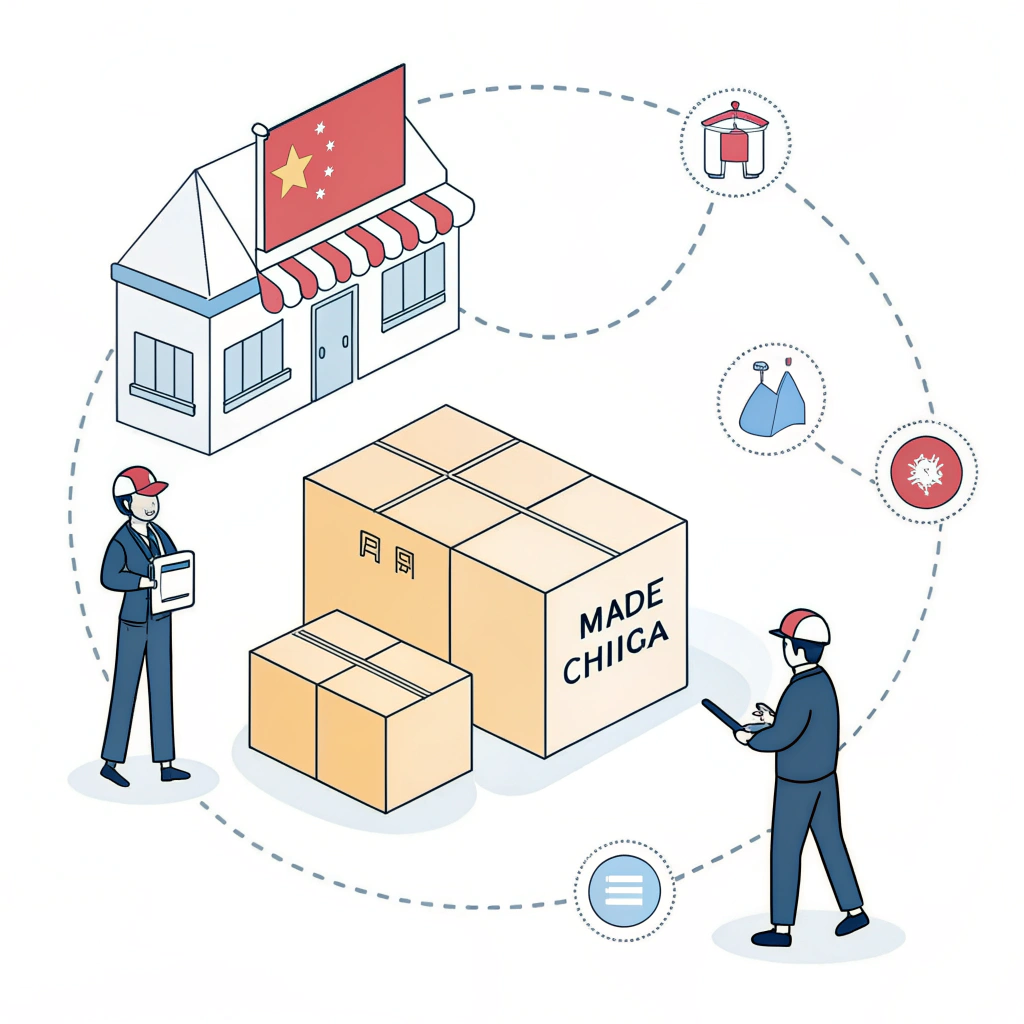
Most overseas markets treat “Made in China” as the clearest and safest origin mark. “Made in PRC” is an abbreviation for People’s Republic of China and may be rejected by some customs authorities (notably U.S. CBP) or retailers because it isn’t always unmistakable to the average consumer. It does not affect tariffs, anti‑dumping or countervailing duties1. If you’re shipping to the U.S., use “Made in China.” For the EU, UK, Canada and Australia, “Made in China” is also the low‑risk default unless a retailer explicitly approves “PRC.”
Why the distinction matters for importers
- The phrase you print on the product and packaging is part of country of origin (COO) labeling2. It is visible to customs examiners, retail compliance teams, and consumers.
- If you get COO wrong, you risk marking penalties, rework costs, retail chargebacks, shipment delays, or seizures.
- Your tariff exposure, anti‑dumping (AD) and countervailing (CVD) duties, and Section 301 measures depend on origin determination, not the wording of the label—but mislabeling can trigger enforcement that exposes the rest of your entry to scrutiny.
Regulatory baseline you should know
- United States (19 U.S.C. §1304; 19 CFR Part 134): Imported goods must be marked in English with the country of origin in a manner that is conspicuous, legible, indelible, and permanent to the “ultimate purchaser.” Abbreviations are permitted only if they unmistakably indicate the country (19 CFR 134.45). In practice, “Made in China” is expected. “PRC” alone is often viewed as unclear; if used, pair it with “China” (e.g., “Made in P.R.C. (China)”).
- European Union (Union Customs Code, Regulation (EU) No 952/2013): Non‑preferential origin3 determines duties and trade defense, but the EU does not impose a harmonized mandatory origin mark for most goods. Many retailers require a clear English mark for global packaging. “Made in China” is broadly accepted; “PRC” may be allowed if retailer policy accepts it.
- United Kingdom: No general mandatory origin mark for all goods, but any origin claim must be truthful and not misleading under consumer protection rules. Retailers typically prefer “Made in China.”
- Canada (CBSA “Marking of Imported Goods Regulations” and D‑Memos): Certain goods require English or French origin marking. Abbreviations must not mislead. “Made in China” and/or bilingual “Fabriqué en Chine” is recommended.
- Australia (Australian Consumer Law, Competition and Consumer Act 2010, Sch. 2): Origin claims must be accurate; sector‑specific rules exist. “Made in China” is standard.

“Made in PRC” vs. “Made in China” — decision summary
- Clarity: “Made in China” is immediately understood by consumers and inspectors; “PRC” is jargon outside trade circles.
- Legal risk: U.S. CBP can assess special marking duty (10% ad valorem) for non‑compliant marking. Using “PRC” alone increases the chance of re‑marking demands.
- Retail acceptance: Many global retailers (including online marketplaces) specify “Made in China” in compliance guides. Deviating without approval risks chargebacks and relabeling.
- Tariff impact: The choice of wording does not change duty liability if the true origin is China. Mislabeling can trigger exams, delays, and broader entry scrutiny.
Multi‑jurisdiction comparison
| Market | Is “PRC” acceptable on product? | Low‑risk best practice label | Notes |
|---|---|---|---|
| United States | Risky; may be rejected if “China” not present | “Made in China” | 19 U.S.C. §1304; 19 CFR Part 134; abbreviations must be unmistakable |
| European Union | Usually retailer‑driven; “PRC” may be accepted if policy allows | “Made in China” | No EU‑wide mandatory origin mark for most goods |
| United Kingdom | Case‑by‑case; avoid consumer confusion | “Made in China” | Must not mislead under consumer protection rules |
| Canada | Use English/French; avoid ambiguous abbreviations | “Made in China” / “Fabriqué en Chine” | Marking requirements apply to certain goods |
| Australia | Not harmonized mandatory marking; clarity is key | “Made in China” | Origin claims must be accurate and clear |
What the label does not change
- Tariffs/duties: Section 301 duties in the U.S., MFN rates, and any AD/CVD orders apply based on non‑preferential origin determination—not on whether you print “PRC” or “China.”
- HS/HTS codes4: Classification drives duty rate and controls. The printed origin line does not change the HS/HTS.
- Trade defense exposure: If your product falls under an AD/CVD order for China, labeling “PRC” does not avoid liability. Origin is determined by production steps and substantial transformation5 tests.
Documentation vs. product marking—keep them aligned
- Product/packaging: Use “Made in China” in English; add local language equivalents where required by retailer or national law (e.g., Canada).
- Commercial invoice: State “Country of origin: China.” Avoid mixing terms like “PRC” on the invoice if the product is labeled “China.”
- Certificate of origin: Use “China.” Prefer official chamber formats where needed.
- Customs declaration: Use the appropriate country code (e.g., CN for the U.S. entry system), consistent with the printed origin.
- Supplier packing list wording: Align with the product mark. Example line: “COO: China. Outer carton and unit packaging printed ‘Made in China’.”
- Retailer compliance portals: Mirror the exact wording approved by the retailer; do not assume “PRC” will pass.

U.S. marking essentials (19 CFR Part 134)
- Who must be marked? Most imported articles unless exempt (e.g., certain raw materials or if only the container needs marking under specific exceptions—see 19 CFR 134.32).
- How to mark? Conspicuous, legible, indelible, and permanent; in English; visible to the ultimate purchaser.
- Where? On the article itself; container marking may suffice only when the article will remain in the container until delivery to the ultimate purchaser.
- Penalty for non‑compliance: Special marking duty of 10% ad valorem and potential demands to re‑mark before release.
Practical U.S. examples
- Apparel polybags: Print “Made in China” on the garment neck label or sewn‑in label; polybag marking alone is risky unless the garment will never be removed before sale.
- Hardgoods: Etch, sticker (industrial adhesive), or molded marking “Made in China” on the unit; outer carton must also carry clear origin.
- Small items: Use a durable, legible sticker; avoid microscopic fonts and easily removable labels.
Retailer and marketplace realities
- Major retailers and marketplaces often publish compliance handbooks that call for “Made in China” verbatim. Using “PRC” without prior written approval risks:
- Non‑compliance chargebacks
- Returns to vendor
- Re‑stickering costs at destination distribution centers
- Consumer perception: If your brand uses “PRC,” expect customer service questions and potential confusion. Simplicity reduces friction.
A practical decision guide
- Shipments to the U.S.: Use “Made in China.” If a buyer insists on “PRC,” add “China” in parentheses: “Made in P.R.C. (China).”
- Global packaging serving multiple regions: Default to “Made in China,” plus local language where required. Avoid creating separate “PRC” art unless mandated.
- Customer‑specific labeling: Only accept “PRC” when the customer provides written specification and confirms local legal acceptability.
- Replacement parts, warranty labels, e‑commerce listings: Keep the wording consistent across all touchpoints to avoid misleading claims.
Supplier instruction template (copy/paste)
- Country of origin: China.
- Unit marking: “Made in China” in English, minimum 2–3 mm font, high contrast, durable (molded/etched or permanent sticker).
- Inner packaging: “Made in China” visible on any polybag or inner box.
- Outer carton: “Made in China” on at least one main panel; include SKU, PO, and carton count.
- Documents: Commercial invoice and packing list to state “Country of Origin: China.”
- If bilingual required: Add “Fabriqué en Chine” below the English line for Canada.
- No abbreviations (“PRC,” “P.R.C.”) unless buyer provides written approval and we add “(China)” alongside.

Checklist to avoid delays and penalties
- Confirm origin determination with your manufacturer (substantial transformation occurred in China?).
- Align product mark, packaging, invoice, and customs entry—use “China” consistently.
- Validate retailer requirements; capture them in the PO and QC checklist.
- Conduct pre‑shipment QC: Verify “Made in China” placement, legibility, permanence.
- Keep photo evidence of marking per SKU in your compliance files.
- Train your inspection team to flag any “PRC” usage not approved in writing.
- Prepare fallback labels at destination DCs in case of minor non‑compliance.
- Review sector‑specific rules (e.g., textiles labeling, electrical safety marks) that can interact with COO.
Edge cases importers often miss
- Hong Kong, Macau, Taiwan: Origins are distinct. If true origin is Hong Kong, mark “Made in Hong Kong,” not China.
- Multi‑country processing: If substantial transformation occurs in another country (e.g., final assembly in Vietnam), the origin (and mark) changes accordingly.
- Container marking exceptions: If the article will remain in the container until sale, container marking may suffice—but this is narrow and fact‑specific. When in doubt, mark the product itself.
- Repack at destination: If you repackage after customs clearance, ensure the resulting packaging still displays the correct origin in a compliant manner.
Bottom line
- For almost all practical scenarios, “Made in China” is the safest and most widely accepted origin label. “Made in PRC” adds ambiguity without benefit and can create real compliance and retail risks. Use “China” on product, packaging, and documents; confirm any exception in writing with your buyer and check local rules before deviating.
People Also Ask
Q: What is the 0.1% rule in China?
A: The “0.1%” threshold is sometimes cited in the context of export‑control de minimis for certain Chinese‑origin rare earth materials. It does not relate to country‑of‑origin marking for imports. COO labels like “Made in China” are governed by customs marking rules in the destination market, not by this threshold.
Q: Are products Made in China required to say Made in China?
A: In the United States, yes—most imported goods must be marked in English with their country of origin (19 U.S.C. §1304; 19 CFR Part 134). “Made in China” is the accepted wording. Other markets may not mandate origin marks universally, but if you choose to mark, it must be clear and not misleading; “Made in China” is the safest choice.
-
anti‑dumping or countervailing duties: Reading will explain how AD/CVD trade remedies work, how orders are applied, and how they interact with origin and documentation so you can assess risk and landed cost accurately. ↩
-
country of origin (COO) labeling: Reading will clarify the legal requirements, placement, and permanence standards for COO marks, and how to align product, packaging, and documents to avoid penalties and delays. ↩
-
Non‑preferential origin: Reading will help you understand the rules used to determine origin for duty and trade defense (distinct from preferential origin), with guidance on evidence and declarations for compliance. ↩
-
HS/HTS codes: Reading will teach correct classification principles, common pitfalls, and how codes drive duty rates, admissibility, and regulatory requirements—reducing audit risk and overpaying duties. ↩
-
substantial transformation: Reading will demystify the test customs uses to assign origin when multiple countries are involved, with industry examples to evaluate manufacturing scenarios and avoid mislabeling. ↩