Skip to content
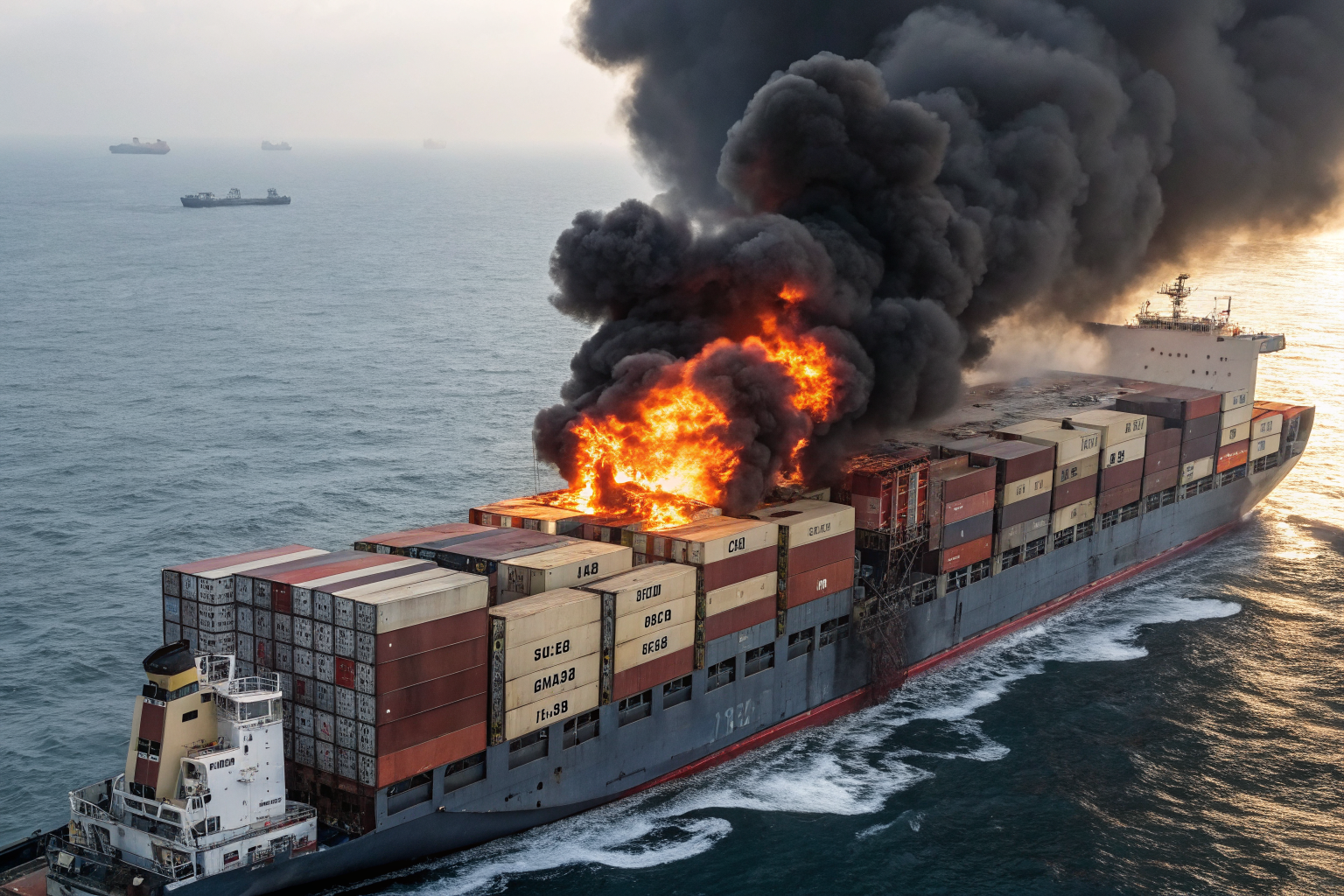
If your container is damaged in a fire caused by dangerous goods on the same vessel, the shipping line will not compensate you for your losses. Your only recourse is through cargo insurance, business interruption insurance, or liability clauses in your customer contracts—otherwise, you face paying freight costs and customer compensation with no recovery.
Container fires at sea represent one of the most financially devastating scenarios for importers, yet few businesses adequately prepare for this risk. Between 2018 and 2022, maritime industry reports documented over 1,500 container fires aboard vessels, with average losses exceeding $180,000 per affected shipper. Understanding your liability, insurance options, and contractual protections is essential for any business shipping goods from China to the USA.
Why Shipping Lines Won't Compensate for Fire Damage
Shipping lines operate under the principle of "General Average," a centuries-old maritime law that protects carriers from liability when cargo is damaged or destroyed during extraordinary events at sea. When a fire breaks out on a vessel—whether caused by misdeclared hazardous materials, battery cargo, or other dangerous goods—the shipping line invokes General Average to distribute losses among all cargo owners proportionally.
This means not only will the carrier refuse to compensate you for your destroyed cargo, but they may also demand you contribute to the costs of fighting the fire, salvage operations, and vessel repairs. General Average claims typically range from 15% to 40% of your cargo value, depending on the severity of the incident. Your cargo will be held at the destination port until you either pay the General Average deposit or provide a guarantee from your insurance company.
At King-Hor Supply Chain, we've assisted over 1,000 clients with China-to-USA ocean freight shipments since 2015, and we've witnessed firsthand how devastating these incidents can be for unprepared importers. The 2019 Maersk Honam fire, which killed five crew members and destroyed cargo valued at over $500 million, resulted in General Average claims that lasted over three years.
Your Three-Layer Protection Strategy Against Container Fire Losses
Protecting your business from container fire losses requires a comprehensive three-layer insurance and contractual approach that addresses cargo value, business operations, and customer obligations.
Layer 1: Cargo Insurance (Marine Cargo Insurance)
Marine cargo insurance should be your first line of defense for any shipment valued over $10,000. The cost typically ranges from 0.3% to 1.2% of cargo value depending on the goods, route, and coverage level. For example, a $50,000 electronics shipment from Shenzhen to Los Angeles would cost approximately $150-$600 to insure.
Standard marine cargo insurance provides coverage at 110% of commercial invoice value, compensating not just for the goods but also for expected profit margins. This coverage includes fire damage from any source, including fires caused by other containers' dangerous goods. King-Hor Supply Chain partners with leading marine insurance providers to offer our clients competitive rates and streamlined claims processing through our Los Angeles and Shenzhen offices.
| Coverage Type | Protection Level | Typical Cost | Includes General Average |
|---|---|---|---|
| Institute Cargo Clause A (All Risk) | Comprehensive coverage including fire, water damage, theft | 0.8% - 1.2% of cargo value | Yes |
| Institute Cargo Clause B (Named Perils) | Fire, explosion, collision, general average | 0.5% - 0.8% of cargo value | Yes |
| Institute Cargo Clause C (Minimum) | Major casualties only | 0.3% - 0.5% of cargo value | Yes |
| No Insurance | None - full loss exposure | $0 | Must pay out of pocket |
Layer 2: Business Interruption Insurance
While cargo insurance covers the physical goods, business interruption insurance protects against lost revenue, customer penalties, and operational costs when your shipment is delayed or destroyed. This coverage is particularly critical for Amazon FBA sellers and businesses with just-in-time inventory systems.
A typical business interruption policy for importers costs $800-$2,500 annually and covers lost profits for 30-180 days following a covered event. For businesses operating on tight margins or those with large customer contracts, this protection can mean the difference between weathering a crisis and facing bankruptcy.
Layer 3: Contractual Liability Clauses
Your sales contracts with customers must include force majeure clauses and transportation liability limitations. These clauses should specifically address:
- Fire or explosion aboard the carrying vessel
- General Average declarations and associated delays
- Container loss at sea due to severe weather
- Delays caused by salvage operations or port diversions
- Limits on your liability for delivery delays beyond your control
A well-drafted contract clause might state: "Seller shall not be liable for delays or non-delivery resulting from maritime casualties including but not limited to vessel fires, containers lost at sea, or General Average declarations. Buyer acknowledges that ocean freight involves inherent risks beyond Seller's control."
What are the 7 fire safety rules?
The 7 fire safety rules for container shipping are: proper hazardous materials declaration, correct classification and labeling, adequate packaging and separation, temperature-controlled cargo monitoring, prohibition of incompatible goods stowage together, mandatory crew training on fire response, and regular fire detection system maintenance.
These rules are established by the International Maritime Organization (IMO) through the International Maritime Dangerous Goods (IMDG) Code. However, violations remain common. Industry estimates suggest 10-15% of containers carrying dangerous goods are misdeclared or improperly packaged—the leading cause of container fires at sea.
The most critical rule for importers is ensuring your Chinese suppliers properly declare all cargo contents. Lithium batteries, aerosols, chemicals, and even certain cosmetics require special documentation and handling. At King-Hor Supply Chain, our customs clearance team reviews all shipment documentation to verify proper hazmat declarations before cargo leaves our Shenzhen facility, reducing fire risk and preventing costly delays.
Common dangerous goods found in routine shipments include:
- Lithium-ion batteries (Class 9): Found in electronics, power banks, electric bikes
- Aerosols (Class 2.1): Hair spray, spray paint, compressed air
- Flammable liquids (Class 3): Perfumes, hand sanitizer, adhesives
- Oxidizing substances (Class 5.1): Pool chemicals, fertilizers
- Corrosive materials (Class 8): Batteries, cleaning products
How to fight container fire on ship?
Container fires on ships are fought using a combination of water flooding systems, CO2 suppression in cargo holds, boundary cooling to prevent fire spread, and sometimes controlled burning when safe extinguishment is impossible. Crew members cannot directly access burning containers stacked in the hold, making these fires particularly difficult to control.
Modern container vessels are equipped with sophisticated fire detection and suppression systems, but their effectiveness is limited by the nature of containerized cargo. Once a fire starts inside a sealed container—especially one containing lithium batteries or other self-oxidizing materials—it can burn for days or weeks despite external cooling efforts.
The 2020 X-Press Pearl fire off Sri Lanka burned for 13 days despite continuous firefighting efforts, ultimately destroying 1,486 containers and causing over $300 million in losses. The 2022 Felicity Ace fire burned for 16 days before the vessel sank, destroying 4,000 luxury vehicles valued at $438 million.
As an importer, understanding these response limitations reinforces why insurance is non-negotiable. When a fire breaks out, your cargo's fate depends on factors completely beyond anyone's control: the fire's location in the vessel, wind conditions, proximity to port, and whether the fire involves self-sustaining chemical reactions.
What if a container falls from a ship?
If a container falls from a ship, it becomes an immediate total loss with no compensation from the shipping line unless you have marine cargo insurance, as carriers limit liability to approximately $500 per container under international conventions. The World Shipping Council reports an average of 1,500 containers are lost at sea annually, representing roughly $200-300 million in cargo value.
Container losses typically occur during severe weather when ships encounter heavy seas that cause cargo to shift or lashing systems to fail. The most catastrophic incident occurred in November 2020 when the ONE Apus lost 1,816 containers in a single storm between China and the United States—the largest container loss in modern maritime history.
Under the Carriage of Goods by Sea Act (COGSA), which governs most US-bound shipments, carrier liability is limited to $500 per package or customary freight unit—not per container. This means if your container holds 500 boxes of electronics worth $100,000, your maximum recovery from the shipping line would be just $500 total unless you declared a higher value and paid additional freight charges.
King-Hor Supply Chain's door-to-door Amazon FBA services include insurance recommendations based on cargo value and shipping route. For high-value electronics, seasonal goods, or time-sensitive shipments, we strongly advise comprehensive all-risk marine insurance as standard practice.
Building a Risk Management Culture in Your Import Business
Professional importers understand that ocean freight incidents—while statistically uncommon—carry catastrophic financial consequences when they occur. A single uninsured container loss can wipe out an entire year's profits or force a small business into bankruptcy.
Smart risk management involves several practical steps:
- Insure all shipments over $10,000: The 0.5-1% cost is negligible compared to 100% loss exposure
- Diversify your shipping schedule: Avoid placing all inventory on a single vessel
- Maintain safety stock: Keep 30-60 days of inventory in King-Hor's LA warehouse to buffer against transit delays
- Review supplier declarations: Personally verify that hazardous materials are properly documented
- Document everything: Keep copies of all shipping documents, insurance policies, and contracts
- Include contract protections: Clearly define liability limits with your customers
Over our 9+ years managing China-USA freight forwarding, King-Hor has helped clients navigate dozens of cargo incidents including fires, vessel groundings, and container losses. Clients with proper insurance recovered 110% of cargo value within 60-90 days. Those without insurance faced complete losses, freight charges, General Average contributions, and customer lawsuits—total losses often exceeding 300% of the original cargo value.
The Real Cost of "Saving Money" on Insurance
Many importers, especially newer Amazon FBA sellers, view cargo insurance as an unnecessary expense that erodes already-thin margins. This perspective ignores the mathematical reality of risk exposure.
Consider a typical scenario: You import 10 containers annually from China, each valued at $40,000, for total annual imports of $400,000. All-risk cargo insurance costs approximately $3,200 per year (0.8% of cargo value). Over 10 years, you'll pay $32,000 in insurance premiums.
Now consider the risk: If just one container is destroyed in a fire during those 10 years—a probability of roughly 2-3% based on industry statistics—you face a $44,000 loss ($40,000 cargo value plus $4,000 in freight and related costs). Plus, you'll likely owe 20-30% of cargo value ($8,000-12,000) for General Average contributions.
The uninsured importer risks $52,000-56,000 to "save" $3,200 annually—a decision that makes no financial sense regardless of your risk tolerance.
How King-Hor Supply Chain Protects Your Shipments
At King-Hor Supply Chain, cargo protection is integrated into every service we provide. Our comprehensive approach includes:
- Pre-shipment verification: Our Shenzhen team inspects cargo and verifies proper dangerous goods declarations before containers leave China
- Insurance coordination: We facilitate marine cargo insurance through our partner networks at competitive group rates
- Real-time tracking: Monitor your containers throughout the journey with immediate notification of any vessel incidents
- LA warehousing: Store safety stock in our Los Angeles facility to maintain business continuity during transit disruptions
- Claims support: Our experienced team assists with insurance claims and General Average responses, navigating complex maritime law on your behalf
- Contract review: We help clients develop appropriate liability clauses for customer contracts
With offices strategically located in Shenzhen, Los Angeles, and Hong Kong, King-Hor provides end-to-end visibility and support throughout the supply chain. Our 9+ years of experience and 1,000+ satisfied clients demonstrate our commitment to protecting your cargo and your business.
Take Action to Protect Your Business Today
Container fires, losses at sea, and General Average declarations represent serious threats to your importing business. Don't wait for a catastrophic loss to implement proper risk management. Every day your cargo travels without adequate insurance exposes you to potentially devastating financial consequences.
Contact King-Hor Supply Chain today for a comprehensive shipping risk assessment and insurance quote. Our team will review your current coverage, identify gaps in protection, and provide solutions tailored to your specific cargo types and shipping volumes. Whether you're importing electronics, textiles, home goods, or Amazon FBA inventory, we'll ensure your shipments are properly protected from origin to destination.
Get your free shipping quote and risk assessment: Reach out to our team through our website or contact our Los Angeles office directly. With King-Hor's ocean freight, air freight, customs clearance, and warehousing services, plus comprehensive insurance coordination, you'll have everything needed to import confidently from China. Don't let an uninsured loss destroy the business you've worked so hard to build—protect your cargo, protect your profits, and protect your future.