Skip to content
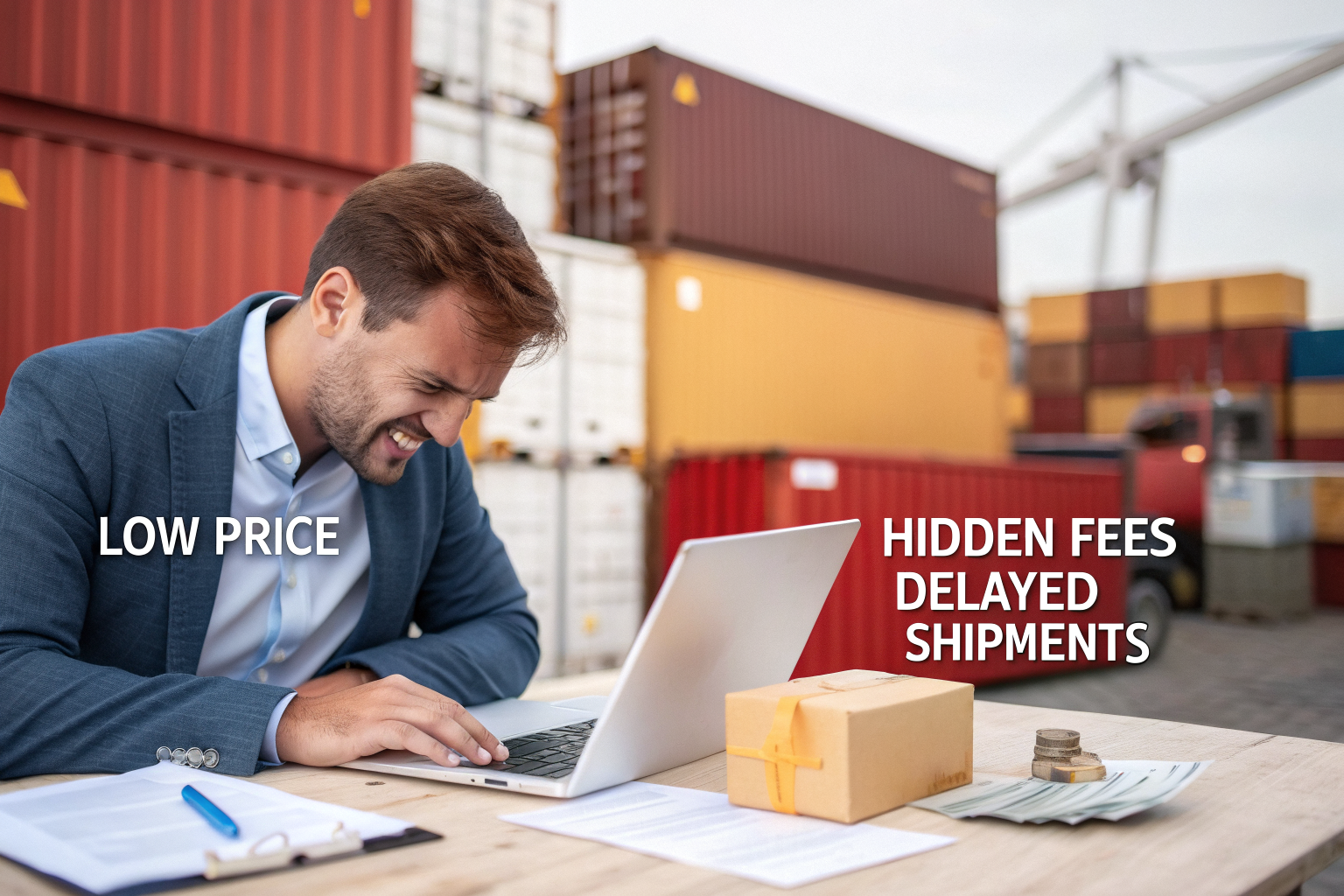
The cheapest freight quote rarely translates to the lowest total landed cost—hidden fees, service gaps, and delays often turn budget carriers into expensive mistakes. When sourcing from China or managing Amazon FBA inventory, importers frequently chase the lowest per-pound rate only to discover unexpected charges, missed delivery windows, and damaged cargo that erase any initial savings. This article reveals why cheapest freight quotes often cost more and how to evaluate true shipping value.
Why Does the Lowest Price Quote Often Lead to Higher Total Costs?
The lowest-priced quote can hide significant hidden expenses that accumulate across your supply chain. Budget carriers achieve rock-bottom rates by cutting corners on infrastructure, capacity, tracking, and customer service—costs that transfer directly to you through delays, re-shipments, and operational disruptions.
At King-Hor Supply Chain, we've tracked this pattern across 1,000+ clients over 9+ years of China-to-USA freight forwarding. A shipment quoted at $0.85/lb by a discount carrier might charge an additional $400 in fuel surcharges, $300 in port fees, $250 in documentation, and $600 in expedited handling after a two-week delay. That same shipment through a transparent partner costs $1.10/lb but includes all-in pricing with zero surprises.
Consider this real scenario: an Amazon FBA seller received a quote for $4,200 to ship 12,000 units (40 cu ft) from Shenzhen. The low-cost carrier didn't mention:
- Peak season surcharges (+$800)
- Customs brokerage fees (+$350)
- LA warehouse handling (+$200)
- Detention charges for slow port clearance (+$500)
The actual bill: $6,050—44% higher than quoted. With King-Hor's transparent ocean freight service, that same shipment cost $4,900 all-inclusive, delivered to the FBA facility in Los Angeles within 21 days, with zero surprises.
What Are the Most Common Mistakes in Carrier Pricing?
The biggest mistake importers make is comparing apples to oranges—quotes that exclude critical cost components—rather than evaluating total landed cost across all variables. Hidden pricing mistakes fall into predictable categories that crush margins and delay shipments.
1. Incomplete Rate Sheets
Budget carriers quote only the base ocean freight rate, excluding:
- Fuel surcharges (typically 5-15% of base rate, volatile with crude oil)
- Currency adjustment factors (CAF) (1-3% depending on USD/CNY fluctuations)
- Peak season premiums (20-40% during August-October for Amazon sellers)
- Port congestion fees ($200-$600 per container, especially LA)
2. Vague Incoterms and Responsibility Lines
A quote marked "FOB Shanghai" means the carrier's responsibility ends at the China dock. You absorb all costs after that—ocean freight, marine insurance, US port fees, customs clearance, inland trucking, and warehouse handling. Quotes should clearly specify CIF (Cost, Insurance, Freight) or door-to-door DDP (Delivered Duty Paid) to prevent cost surprises.
3. No Contingency for Service Failures
Discount carriers don't include buffer time. A 20-day transit promise becomes 30 days when delays occur (equipment failures, port congestion, weather). Late arrivals at Amazon FBA facilities trigger storage fees ($0.87/cu ft/month) and missed seasonal demand windows. King-Hor's 9+ years managing China-to-USA corridors includes realistic transit windows with documented performance: 18-24 days ocean freight, 3-5 days LA warehouse processing.
How to Negotiate Better Freight Rates Without Sacrificing Service Quality?
Negotiating freight effectively requires understanding carrier economics and using leverage strategically—volume commitments, consistent booking patterns, and transparency attract better pricing from quality providers.
Volume Commitment Strategy
One FCL (20-foot container) = minimal negotiating power. Carriers prioritize shippers booking 2+ containers monthly. If your business ships 4-6 FCL/month from China, you qualify for contract rates that are 8-15% better than spot pricing. A 40ft container averaging 25 CBM might be quoted at $2,800 spot rate but negotiated to $2,380 under a quarterly commitment.
Bundling Services for Discounts
Carriers reward shippers who consolidate services under one vendor:
| Service Bundle | Spot Pricing | Bundled Pricing | Annual Savings (12 containers) |
|---|---|---|---|
| Ocean freight only | $2,800/container | $2,800/container | $0 |
| Ocean + customs | $2,800 + $350 | $3,050 | $1,200 |
| Ocean + customs + LA warehouse | $3,150 + $400 | $3,250 | $2,400 |
| Ocean + customs + warehouse + FBA door-to-door | $3,550 + $600 | $3,950 | $3,600 |
King-Hor's integrated model (ocean freight, customs clearance, LA warehousing, and Amazon FBA door-to-door delivery) locks clients into rates 12-18% better than piecemeal carriers because we internalize handoff costs and reduce administrative overhead.
Timing and Flexibility Negotiations
Flexible shippers—willing to consolidate with other customers or accept slightly longer transit windows—secure 5-10% better rates. If you can absorb a 24-25 day ocean freight window instead of demanding guaranteed 18 days, you unlock cost savings. Conversely, pushing guaranteed 15-day windows will cost 20-30% premiums that destroy ROI on low-margin products.
What Is the Average Markup on Freight and How Do Quality Carriers Justify It?
Freight forwarders typically mark up ocean freight 8-15% above carrier cost, but the markup covers real services that discount carriers omit.
Carrier Cost vs. Forwarder Markup Breakdown
A typical 40ft container Shanghai-to-Los Angeles (ocean only):
- Carrier base rate: $2,200
- Fuel surcharge: +$300
- Port fees (Shanghai): +$200
- Carrier total cost: $2,700
- Forwarder markup (10%): +$270
- Client invoice: $2,970
That $270 markup funds:
- Documentation & compliance ($80): Creating bills of lading, commercial invoices, certificates of origin, export licenses
- Customer service ($100): Dedicated account management, real-time tracking, issue resolution
- Risk management ($60): Marine insurance coordination, liability coverage, damage claims handling
- Technology infrastructure ($30): API integrations, tracking portals, document management systems
Budget carriers absorb these costs by automating them away—zero customer service, minimal documentation support, self-service tracking only. This works fine until your shipment gets stuck, and you need someone who can actually call the port authority or negotiate with customs.
Key Cost Drivers That Vary by Carrier
Understanding which variables move your total cost helps you negotiate smarter contracts:
Transit Time Reliability
A 25-day commitment with 95% on-time performance (King-Hor's standard) saves you inventory holding costs, FBA storage penalties, and missed seasonal windows. A budget carrier promising 18 days but delivering in 28 days (60% reliability) costs $2,400+ in extra Amazon FBA storage fees on a standard shipment.
Damage and Claims Processing
Quality carriers minimize cargo damage (0.8-1.2% loss rate) and process claims within 30 days. Discount carriers average 3-5% damage rates and 90+ day claim settlements. On a $15,000 shipment, a 4% damage difference costs you $600, plus you wait months for reimbursement.
Customs Clearance Speed
Experienced US customs brokers clear shipments within 24-48 hours. New brokers or budget carriers take 5-7 days, costing you $350-$800 in port demurrage and detention. King-Hor's LA warehousing facility includes pre-clearance coordination, reducing hold-up time to 18-24 hours average.
Frequently Asked Questions
| Question | Answer |
|---|---|
| Should I always get three quotes? | Yes, but compare apples-to-apples: ocean only vs. door-to-door. Low quotes often exclude critical components like customs, insurance, or final delivery. Ensure all quotes specify the same Incoterm (FOB, CIF, DDP), transit time window, and included services. |
| What's a "red flag" pricing indicator? | Quotes 25%+ below market average, no mention of surcharges or peak season adjustments, vague Incoterms, and unresponsive account managers. If pricing seems too good to verify, request a detailed cost breakdown before committing. |
| Can I negotiate after booking? | No—rates lock at booking confirmation. Negotiate before finalizing contracts. Volume commitments (quarterly or annual) are your best leverage for ongoing discounts. |
| Is air freight ever cheaper than ocean? | Only for urgent, low-weight shipments (<1,000 lbs). Air freight costs $4-8/lb vs. ocean at $0.80-1.20/lb. For most Amazon FBA and B2B bulk sourcing, ocean freight is 70-80% cheaper when you factor in total landed cost and plan properly. |
| What should total landed cost include? | Ocean/air freight, fuel surcharges, port fees, customs duties and taxes, brokerage fees, insurance, inland trucking, warehousing, final delivery. The best quotes break down each component so you understand where money goes. |
The King-Hor Advantage: Transparent Pricing, Proven Performance
Since 2015, King-Hor Supply Chain has served 1,000+ importers, Amazon FBA sellers, and B2B businesses with honest, all-inclusive freight pricing. Our service stack includes:
- Ocean Freight Shanghai/Shenzhen to Los Angeles: 18-24 day transit, all-in pricing with zero hidden fees
- Air Freight for Urgent Shipments: 5-7 day doors with real-time tracking
- Amazon FBA Door-to-Door: Shenzhen to FBA facility in 21 days, managed receiving included
- Customs Clearance: Pre-clearance coordination, 24-hour processing at US ports
- LA Warehouse & Consolidation: Break-bulk and consolidation services, temporary storage, FBA prep
Our clients pay 12-18% more per shipment than the cheapest quote but save 30-40% on total landed cost through eliminated delays, damage prevention, and operational efficiency.
Take Action: Get a Real, Transparent Freight Quote Today
End up paying more by choosing cheap. Instead, contact King-Hor Supply Chain for a detailed, all-inclusive freight quote that breaks down every costing component. Our team will compare your options—ocean vs. air, consolidation opportunities, and timing flexibility—to identify the true lowest total cost, not just the lowest headline price.
Request Your Free Freight Analysis: Email sales@kinghorfreight.com with your shipment details (origin, destination, weight, CBM, timeline), and we'll provide a transparent breakdown within 24 hours. Or call our Los Angeles office for a quick consultation.
Learn why 1,000+ importers trust King-Hor for China-to-USA shipping. Your margin depends on it.