Skip to content
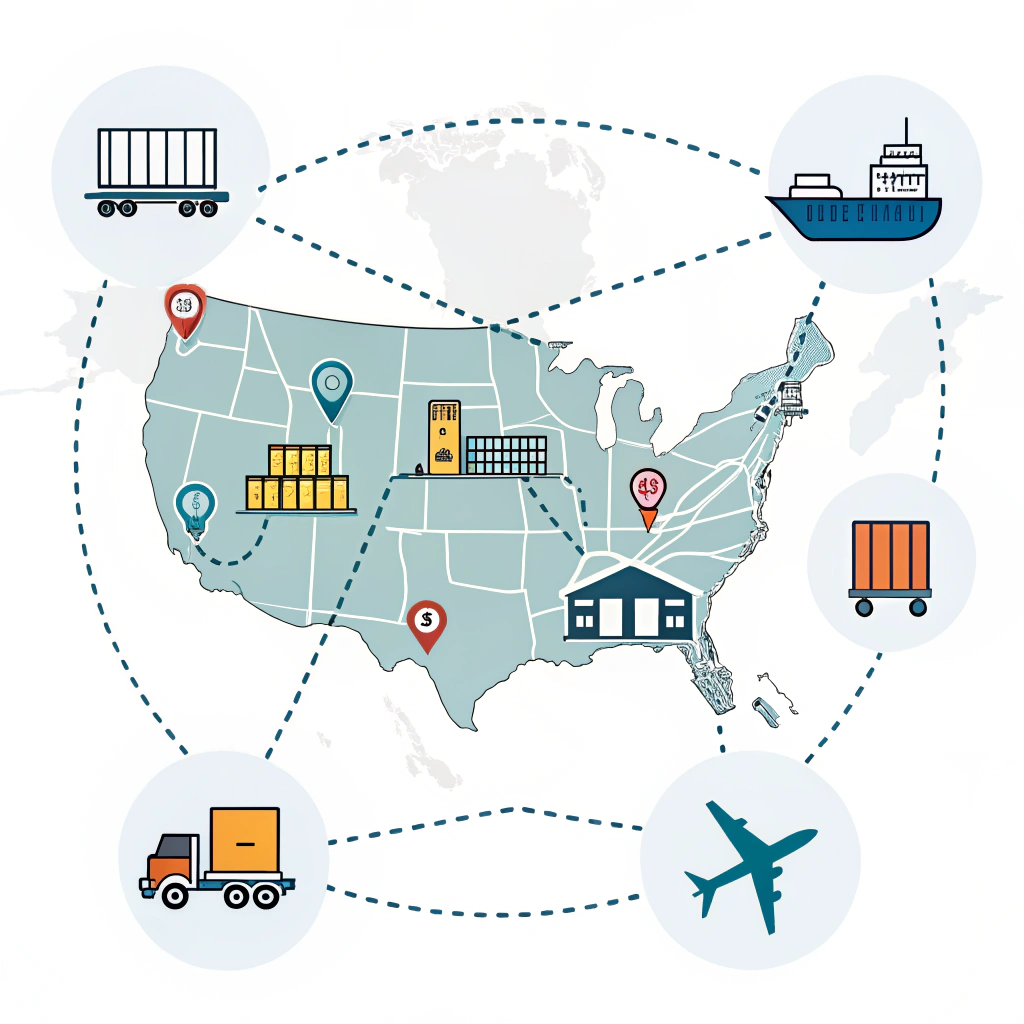
Amazon’s US warehouse network spans hundreds of sites across all regions. For FBA inbound, you don’t “pick” an address—Seller Central assigns one or more Ship-To fulfillment centers (FCs) based on your Inbound Placement1 setting. Use the regional list below to anticipate likely destinations and match ports, then follow the shipping playbook: choose the right mode (air vs ocean, LCL vs FCL), select a compliant Incoterm2 (DDP vs DAP), file ISF/AMS correctly, meet Amazon’s labeling and pallet specs, and secure delivery appointments early to avoid chargebacks.
Understanding Amazon warehouse types (and which matter for FBA inbound)
- Fulfillment Centers (FC): Core FBA receiving and storage nodes. Your shipment plans create Ship-To addresses for these. Example codes you’ll see: ONT8 (CA), JFK8 (NY), FTW1 (TX), MDW2 (IL), PHL4 (PA), CMH1 (OH), BNA3 (TN), CLT2 (NC), LAS7 (NV), PHX3 (AZ), PDX9 (OR), BFI4 (WA), EWR4 (NJ), TPA1 (FL).
- Amazon Receive Centers (AR/ARC): High-volume intake sites where Amazon aggregates before moving inventory to FCs. Inbound Placement may direct you here for single-point delivery.
- Sortation Centers (SC) and Delivery Stations (DS): Downstream, not for FBA inbound.
- Air hubs/gateways (e.g., KCVG): For Amazon Air operations; not typical FBA ship-to addresses.
Key point: Always ship only to the exact address shown in your Seller Central shipment. The list below is for planning and routing strategy, not a substitute for Amazon’s assigned Ship-To.
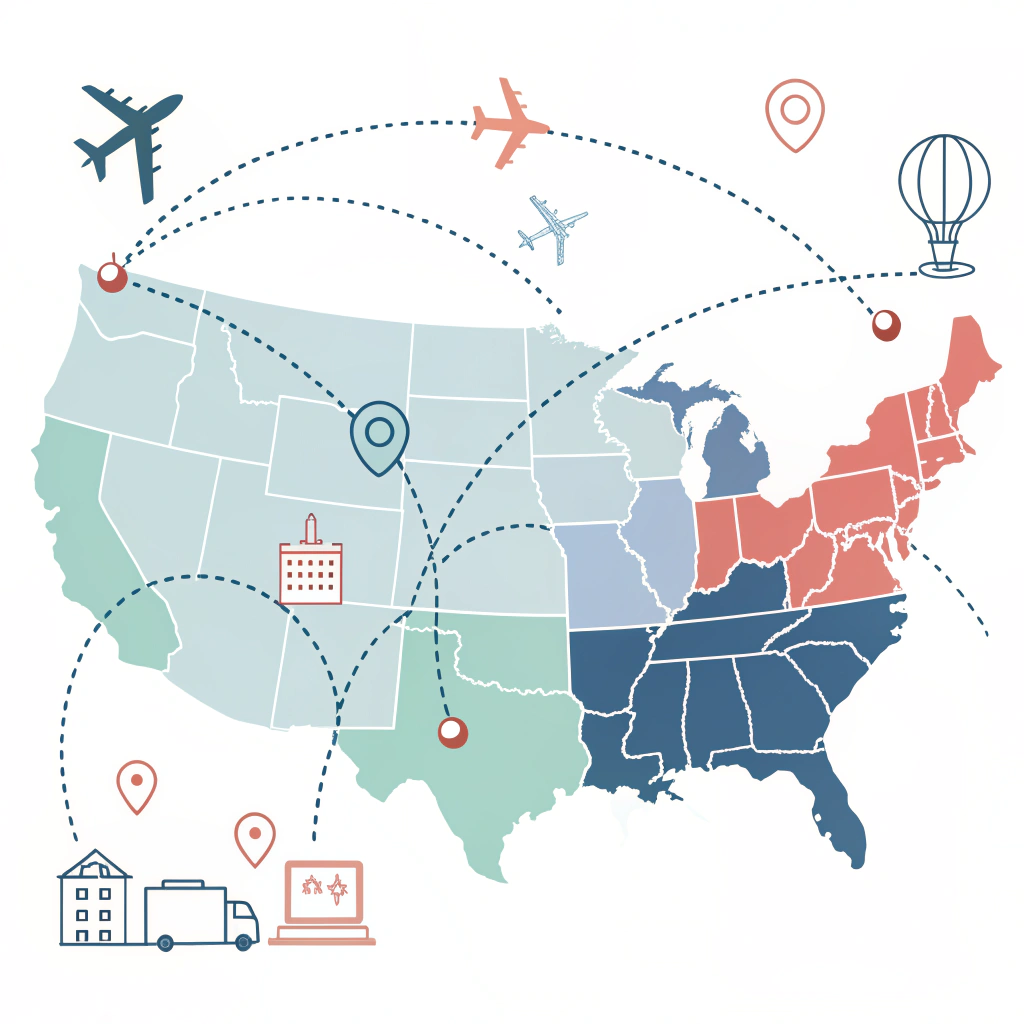
A practical directory of US Amazon fulfillment regions (examples)
Note: Amazon frequently opens, closes, and reassigns sites. The examples help you match regions to ports and plan inland moves. Always use your assigned Ship-To.
West
- California: Inland Empire and Central Valley are major FBA receiving clusters. Example FCs: ONT2/ONT8 (San Bernardino/Eastvale), SCK3/SCK4 (Stockton/Tracy), SMF3 (Sacramento area). Typical US ports/air gateways: Los Angeles/Long Beach (ocean), LAX (air), OAK.
- Arizona: PHX3/PHX6 (Phoenix metro). Ports: LAX/LGB drayage, PHX air.
- Nevada: LAS7 (North Las Vegas), RNO4 (Reno/Sparks). Ports: LAX/LGB; inland haul to NV. RNO4 also links via OAK.
- Washington/Oregon: BFI4 (Kent, WA), PDX9 (Troutdale, OR). Ports: SEA/TAC, Portland.
Mountain/Central
- Texas: FTW1 (Fort Worth), HOU2 (Houston area), SAT2 (San Marcos/Austin–San Antonio corridor). Ports: Houston, LAX/LGB with linehaul; DFW/IAH for air.
- Colorado/Utah/Kansas: Regional intake with periodic FC assignments; plan via DEN/SLC and linehaul from West Coast ports.
Midwest/Great Lakes
- Illinois/Indiana: MDW2/MDW9 (Joliet/Romeoville), IND9 (Plainfield). Ports: Chicago rail ramps from West/East Coast; ORD/IND for air.
- Ohio/Kentucky: CMH1 (Etna), other CMH-area FCs; proximity to CVG air hub. Ports: NY/NJ, Norfolk, Savannah via rail; CMH/CVG for air.
- Michigan/Wisconsin/Minnesota: Assignments vary; plan via Chicago ramps and regional trucking.
Southeast
- Georgia: ATL6 (Atlanta area), SAV-region FCs. Ports: Savannah, Jacksonville; ATL air.
- Tennessee: BNA3 (Nashville area), MEM region. Ports: Savannah/Charleston via rail; BNA/MEM for air.
- North Carolina/South Carolina: CLT2 (Charlotte), GSP/CAE region. Ports: Charleston, Savannah; CLT/RDU for air.
- Florida: TPA1 (Tampa), JAX2 (Jacksonville). Ports: JAX, Port Everglades, Miami; MIA/TPA/JAX for air.
Northeast/Mid-Atlantic
- New York/New Jersey/Pennsylvania: JFK8 (Staten Island, NY), EWR4/EWR9 (Northern NJ), PHL4/AVP1 (Eastern PA). Ports: NY/NJ; EWR/JFK air.
- Maryland/Virginia: BWI2 (Baltimore), RIC2 (Richmond area). Ports: Baltimore, Norfolk; BWI/IAD for air.
- New England: Regional assignments; plan via NY/NJ with onward linehaul.
Tip: If you use Inbound Placement to “single destination,” expect assignments to large AR/FC nodes in the region (e.g., Southern CA, NJ/PA, GA/TN, IL/IN, OH/KY). “Distributed destination” will create multi-FC splits across regions.
Mode and routing: choosing ocean vs air, LCL vs FCL
Use this matrix to decide quickly.
Freight option | Transit (door-to-FC) | Typical use case | Pros | Cons
- | - | - | - | -
Air express (courier) | 3–7 days | Samples, launches <100 kg | Fastest, simplified clearance | Highest cost, size limits
Air freight (consol) | 5–12 days | 0.1–2.0 CBM, urgent | Predictable, scalable | Airport handling, drayage to FC
LCL ocean | 20–35+ days (port/season dependent) | 2–20 CBM | Cheapest at small volumes, flexible | More handoffs, higher damage/delay risk if poorly consolidated
FCL 20'/40' | 18–32+ days | >18–22 CBM | Best per‑unit cost, fewer touches | Requires appointment-ready pallet build, peak-season port risks
Rail/inland after West Coast | Add 3–7 days | East/Midwest FCs | Balances cost/time vs all‑water to East | Rail congestion risk in peak
All‑water to East/Gulf | 28–40+ days | East/South FCs | Avoids West Coast drayage/rail | Longer lead time; Panama/Suez variability
Operational guidance
- If your assigned FCs are West (CA/AZ/NV/WA/OR), favor LAX/LGB or SEA/TAC gateways.
- For Midwest/East assignments, compare: all‑water to SAV/CHS/NYNJ vs West Coast plus rail. Run a landed-cost/time simulation at carton level.
- For split destinations, transload at a coastal warehouse, re-palletize per FC requirements, then LTL to each FC.
DDP vs DAP for Amazon inbound (what works, what breaks)
- DDP (Delivered Duty Paid): Seller is Importer of Record (IOR)3, duties/taxes paid before delivery. Pros: Fewer surprises for the receiver; smoother FC appointments. Cons: You must be a compliant IOR (EIN/CBP number), and your forwarder must execute proper entry. Risk: “Gray DDP” that misdeclares the importer or uses Section 3214 inappropriately can lead to seizures and account risk.
- DAP (Delivered At Place): Duties/taxes not paid. Amazon will not act as IOR. You must designate an IOR and customs broker in the US who clears before final delivery. Pros: Transparency of duty/tax. Cons: If the IOR/broker isn’t ready, shipments stall and miss appointments.
Recommendation
- Parcels/urgent: Use DDP with compliant IOR and correct valuation.
- Palletized LTL/FTL: Either DDP with compliant IOR, or DAP only if your IOR and broker are confirmed, POA on file, and entry instructions completed pre‑arrival.
Customs and security filings (prevent holds and fees)
- Ocean ISF 10+2: File at least 24 hours before vessel loading at origin. Include seller, buyer, importer number (EIN), consignee, manufacturer, HTS code, container stuff location, consolidator.
- AMS/ACE manifest: Ensure data consistency with commercial invoice and packing list.
- Entry: Correct HTS codes, product descriptions, country of origin, FDA/FFC/SPS if applicable. Provide test reports/compliance docs for regulated items.
- Valuation: Declare true transaction value; avoid “sample/no value” on commercial shipments to FBA.
- Wood pallets: ISPM‑155 heat‑treated and marked for US entry.
FBA prep, labeling, and palletization that pass first time
Cartons
- FNSKU or scannable ASIN barcode on every sellable unit unless case‑packed exemptions apply.
- FBA carton labels (2 per carton on opposing sides), readable and not over seams or corners.
- Weight/size: Keep cartons manageable; heavy cartons require “Heavy” labels per Amazon guidance. Avoid long-side oversized cartons; over‑weight or over‑size boxes trigger fees and refusals.
Pallets
- Spec: 40" x 48" standard, 4‑way, Grade A wood, ISPM‑15 compliant.
- Max height: Target 72" (182 cm) inclusive of pallet; keep level and square, no overhang.
- Max weight: Keep within LTL network limits; most FCs accept up to ~1,500 lb per pallet. When in doubt, cap near 1,000–1,200 lb for stability.
- Build: Interlock or column stack per product strength. Use corner boards, top sheet, 3–5 wraps with quality stretch film, and at least 2 straps if needed.
- Labels: 4 pallet labels (one on each side), plus “Mixed SKU” or “Single SKU” placards as applicable.
- Mixed SKUs: Group by SKU in layers; never bury labels; keep ASN/carton counts exact.
Small parcel (SPD) vs LTL/FTL
- SPD (Amazon‑partnered UPS or non‑partnered carriers): Good for small, urgent replenishments. Ensure each carton has the SPD label generated from Seller Central.
- LTL/FTL: Required appointment through Carrier Central. Provide SCAC, shipment ID, pallet count, weight, and contact. Book 2–5 business days ahead; earlier in peak season.
Common chargeback triggers (avoid)
- Appointment no‑shows/late arrival.
- Non‑compliant pallet size/height/overhang.
- Missing carton/pallet labels or unreadable barcodes.
- ASN/carton count mismatch.
- Unsafe pallets (crushed corners, unstable wrap).
Creating a routing plan from China to US Amazon FCs
- Before you ship
- Confirm Inbound Placement setting (single vs distributed). Download the assigned FCs once the plan is built.
- Choose mode: air for speed or ocean for cost. If ocean and split FCs, plan a transload at LA/NY for multi‑stop LTL.
- Decide Incoterm and IOR: If DDP, ensure IOR registration and broker instructions; if DAP, nominate broker and clear pre‑arrival.
- Paperwork: Commercial invoice, packing list, HS codes, FDA/other certificates, FBA labels.
- At origin
- QC and cartonization per Amazon limits; apply FNSKU/barcodes.
- Build Amazon‑compliant pallets at origin if shipping FCL direct to FC; otherwise, build export pallets for consolidation and rework at a US cross‑dock near the final FCs.
- At US gateway (transload scenario)
- De‑vanning, check counts, apply/replace any non‑scannable labels.
- Re‑palletize to 40" x 48", height ≤ 72", add shrink wrap, corner boards, pallet labels.
- Create LTL/FTL deliveries by FC; book Carrier Central appointments.
- Final mile to FC
- Provide carriers with Amazon shipment IDs, reference numbers, and appointment confirmation.
- Monitor ETAs and upload PODs; reconcile received vs shipped cartons to maintain sellable-on-hand accuracy.
Port selection by destination region (rule‑of‑thumb)
- West region FCs (CA/AZ/NV/WA/OR): Use LAX/LGB or SEA/TAC; truck within 1–2 days to most FCs.
- Mountain/Texas: Compare LAX/LGB + linehaul vs Houston direct; for time‑sensitive loads, consider DFW/IAH air.
- Midwest: Compare West Coast + rail to Chicago vs all‑water via East/Gulf, depending on seasonal rail congestion and vessel schedules.
- Southeast: All‑water to Savannah or Charleston reduces inland cost; transload and LTL inland if split FCs.
- Northeast: NY/NJ for shortest drayage; consider Norfolk or Baltimore depending on carrier service and chassis supply.
Quick reference: when to consolidate vs ship direct to FC
- Use origin consolidation when: multiple suppliers, small batches per SKU, and you aim for a single “single‑destination” Inbound Placement. You’ll save on domestic LTL runs.
- Use US transload when: Amazon assigns multiple FCs across regions; ocean to a coastal gateway, then build compliance pallets for each FC and linehaul/LTL.
- Ship FCL direct to FC when: one or two assigned FCs are near the port and you can build final pallets at origin to Amazon spec. This reduces touches and domestic costs.
Risk controls and calendar planning
- Peak seasons (Q3–Q4, Prime events): Book space and FC appointments earlier; expect lead times +5–10 days.
- Free time and demurrage: Align customs release timing with appointment windows; pre‑clear to avoid storage.
- Insurance: All‑risk cargo insurance for ocean and air; declare correct values.
- Compliance audits: For regulated goods (batteries, hazmat, cosmetics, food contact), align SDS, UN markings, and Amazon hazmat approvals before booking.
Examples (how experienced teams execute)
- Example 1: 12 CBM mixed SKUs, assigned ONT8 only. Plan: LCL to LAX, transload at LA warehouse, build 40x48 pallets to 68" height, label, Carrier Central appointment, delivery in 2 business days. Incoterm: DDP with seller as IOR. Result: Gate‑to‑available in 5–7 days post‑arrival.
- Example 2: 1 x 40HQ, assigned FTW1 and PHL4. Plan: All‑water to SAV, transload and split: seven pallets to FTW1 via FTL, six pallets to PHL4 via LTL. Appointments booked at creation of shipment plan. Incoterm: DAP with US broker clearing entry. Result: Both FCs received within 6–9 days of port availability.
- Example 3: 450 kg urgent launch, assigned JFK8. Plan: Direct air freight to JFK, same‑day customs clearance via pre‑filed entry, next‑day LTL with appointment. Result: Inventory received in 3–4 days door‑to‑FC.
Operational checklists you can copy
Pre‑shipment (origin)
- Confirm Inbound Placement setting and assigned FCs in Seller Central.
- Finalize Incoterm (DDP or DAP) and IOR/broker details.
- Create shipment plan; print unit/carton/pallet labels.
- Verify HS codes, invoice values, and product compliance.
- Book space (air/ocean) and file ISF (ocean) before cutoff.
At US entry/transload
- Customs release confirmed; pay duties/taxes (if DAP).
- Count and QC; relabel any smudged/non‑readable barcodes.
- Build 40x48 pallets; height ≤ 72"; add corner boards and 4 pallet labels.
- Generate LTL/FTL tenders; book Carrier Central appointments.
Before delivery
- Share appointment IDs and shipment IDs with the carrier.
- Verify driver instructions: FC address, reference numbers, check‑in rules.
- Confirm pallet count, weight, dimensions per BOL; attach packing list with carton breakdown.
- Track arrival and upload POD; reconcile received quantities.
People Also Ask
How to sell on Amazon USA from another country?
- Set up a North America unified seller account and register required tax and compliance details.
- Decide FBA vs FBM per SKU. For FBA, create inbound shipment plans in Seller Central to generate assigned FC ship‑to addresses.
- Prepare products to US/Amazon standards (labeling, safety/compliance), then ship using a compliant Incoterm (DDP or DAP with a valid Importer of Record).
- Clear customs, deliver to the assigned FCs by appointment, and monitor inventory availability and pricing once received.
How many warehouses does Amazon have across the United States?
Amazon operates hundreds of US facilities, including over one hundred fulfillment centers plus receive, sortation, delivery, and specialty sites. The largest concentrations are in California, Texas, Illinois/Indiana, Florida, New Jersey/Pennsylvania, and Ohio/Kentucky. Exact counts change frequently; rely on the specific Ship‑To details generated in your Seller Central shipment plan for current destinations.
-
Inbound Placement: Reading this will help you understand Amazon’s single vs distributed destination rules, how FC assignments affect freight cost and lead time, and tactics to optimize placement for smoother inbound. ↩
-
Incoterm: Reading this will clarify seller/buyer responsibilities (DDP vs DAP), risk transfer points, and documentation needed to avoid delays, so you can choose the right term for each shipment. ↩
-
Importer of Record (IOR): Reading this will explain legal obligations, registration requirements, and brokerage workflow, helping you set up a compliant IOR and prevent clearance or appointment failures. ↩
-
Section 321: Reading this will outline the US de minimis allowance, when it can be used legitimately, and the enforcement risks of misusing it for commercial FBA shipments. ↩
-
ISPM‑15: Reading this will show pallet heat‑treatment standards and markings required for international shipments, reducing the risk of customs rejections or quarantine at US entry. ↩