Skip to content
If you’re shipping from China to Amazon FBA, choose a transport mode based on weight, volume, and urgency: express courier DDP (3–7 days door-to-door, best under 100 kg), air freight + final-mile truck (6–12 days, best for 100–500 kg), ocean LCL (18–35 days, best for 2–12 cbm), or FCL (full container, 20–40+ days, best >12–15 cbm). Build your landed cost per unit by adding origin fees, freight, customs duties/taxes, and FBA delivery. Then follow a step-by-step inbound process: confirm FBA labeling/packaging, create the shipment plan (SPD/LTL/FTL), book freight using the right Incoterm1 (e.g., DDP/FOB), file ISF/AMS (US), clear customs with the correct HS code, and secure an appointment for delivery to the FC. Amazon cannot be the Importer of Record; ensure IOR/VAT/EORI are arranged before departure.
Problem: One shipment, four systems to coordinate
Shipping to Amazon FBA is a compliance puzzle across four systems that rarely talk to each other:
- Supplier readiness: labeling, packaging, cartonization, battery/hazmat.
- International freight: mode, schedule, space, chargeable weight or CBM.
- Customs: accurate HS code, duties/taxes, filings like ISF and AMS.
- Amazon inbound: shipment plan, SPD/LTL/FTL routing, FC appointment, carrier requirements.
Failures in any system cause refusals, rework, or storage/delay fees. The goal is a low, predictable landed cost with zero inbound defects.
Why shipments to FBA go wrong
- Misapplied Incoterms (e.g., buying EXW/FOB without a forwarder that can do FBA delivery and appointments).
- Wrong packaging: overweight boxes, mixed SKUs, missing FNSKU2 and carton labels.
- Incomplete customs data: vague product description, wrong HS code, missing MSDS for batteries.
- Timing errors: late ISF (US) fines, missing cut-offs, peak season rollovers.
- Final-mile surprises: LTL carriers without Amazon Carrier Central access, no SCAC, or missed appointment windows.
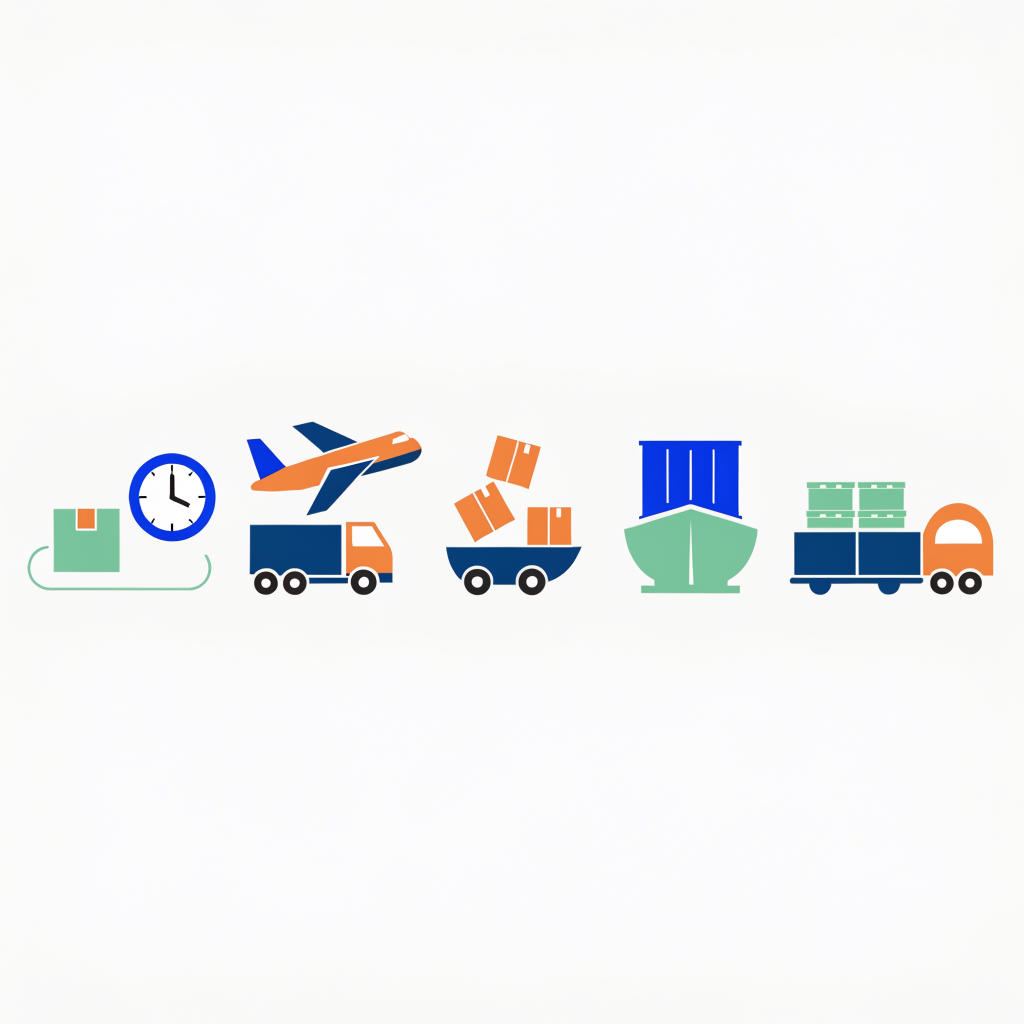
Shipping methods at a glance
Use this quick comparison to choose the right method for your shipment.
| Method | Best for | Typical transit (door-to-FBA) | Cost unit | Pros | Cons |
|---|---|---|---|---|---|
| Express courier DDP (UPS/DHL/FedEx/TNT) | <100 kg, urgent samples and small POs | 3–7 days | per kg (volumetric) | Fastest, low paperwork, minimal handoffs | Costly above 100 kg, battery restrictions, dimensional weight |
| Air freight + truck (DDP/DAP) | 100–500 kg, time-sensitive | 6–12 days | per kg (chargeable) | Predictable, scalable, fewer peak surcharges than express | Requires customs brokerage, airport–FBA truck, box content accuracy |
| Ocean LCL (DDP/DAP) | 2–12 cbm, cost-sensitive, flexible | 18–35 days to US; 25–40 days to EU/UK | per cbm/ton | Lowest cost at lower volumes, weekly sailings | CFS3 handling, possible rollovers, extra handling risks |
| Ocean FCL (20’/40’/HQ) | >12–15 cbm, regular replenishment | 20–40+ days | per container | Lowest unit cost, fewer touch points | Larger cash tie-up, port/rail congestion exposure |
| Rail to EU + truck | 2–20 cbm to EU | 18–25 days | per cbm/ton | Faster than sea to EU, cheaper than air | Limited lanes, space volatility, DG restrictions |
Rule of thumb:
- Under 100 kg or <0.5 cbm: express DDP.
- 100–500 kg or 0.5–2 cbm: air freight + truck.
- 2–12 cbm: ocean LCL.
-
12–15 cbm: ocean FCL.
- To EU with schedule pressure: consider rail.
Incoterms decoded for FBA
Choose Incoterms that align responsibility and control. For FBA-bound freight, DDP is popular but must be done correctly.
| Incoterm | What it means in practice | Pros | Watch-outs |
|---|---|---|---|
| EXW (Ex Works) | Buyer picks up at factory | Full cost control | High origin risk/costs; not recommended without a China-based forwarder |
| FOB (Free on Board) | Supplier delivers to port and clears export | Standard for sea/air | Buyer covers international freight onward; ensure your forwarder handles FBA delivery |
| CIF/CIP | Freight + insurance to destination port/airport | Predictable main leg | Doesn’t include import clearance or FBA delivery; prepare DAP/DDP leg |
| DAP (Delivered at Place) | Delivered to FBA, duties unpaid | Clarity on delivery | You (buyer) arrange duties/taxes with broker |
| DDP (Delivered Duty Paid) | Delivered to FBA with duties/taxes prepaid | Simplicity | Amazon cannot be Importer of Record (IOR); ensure a compliant IOR and tax setup (US: EIN + bond; EU/UK: EORI/VAT) |
Best practice: use FOB or DDP with a forwarder experienced in Amazon appointments, partnered carriers, and IOR/VAT compliance.
End-to-end step-by-step process
- Define the SKU and compliance early
- Confirm HS code and duty rate; check Section 3014/additional tariffs (US) or EU/UK VAT rules.
- Identify DG, batteries, magnets, liquids, food/cosmetics—obtain MSDS/UN38.3 where required.
- Confirm brand/labeling compliance (warnings, country of origin, suffocation labels).
- Prepare packaging and FNSKU labeling
- Each sellable unit needs an FNSKU label.
- Use Amazon-compliant cartons: single-person lift, ideally ≤50 lb (22.7 kg); up to 66 lb only if single oversized unit and properly labeled.
- Standard-size cartons usually ≤25" on any side; avoid overhang on pallets; use new, sturdy boxes.
- Create the shipment plan in Seller Central
- Set ship-from (factory or forwarder’s warehouse).
- Choose inbound mode: SPD (parcel), LTL or FTL.
- Enter “box content” and carton dimensions/weights accurately.
- Accept FC assignment(s). Download carton and pallet labels.
- Decide routing and Incoterm
- Select express, air, LCL, or FCL per weight/volume and due date.
- Align on FOB/DAP/DDP responsibilities with your supplier and forwarder.
- Book export and main leg
- Reserve space with realistic ETD/ETA and cut-offs.
- For US ocean: file ISF at least 24 hours before vessel loading; for air/ocean: submit AMS manifest data.
- Prepare commercial invoice, packing list, HS codes, and certificates if needed.
- Origin consolidation and inspection
- Optional pre-shipment inspection; verify carton count, dimensions, and labels.
- Consolidate multiple factory POs to reduce per-shipment fixed fees.
- Apply Amazon carton/pallet labels at origin where possible.
- Customs clearance at destination
- Ensure Importer of Record (IOR) is established (US: valid EIN and customs bond; EU/UK: EORI and VAT).
- Broker classifies and clears goods; duties/taxes paid (for DDP) before release.
- Final-mile to FBA and appointment
- LTL/FTL carriers must book through Amazon Carrier Central; ensure SCAC is registered.
- For SPD, use approved parcel carriers; apply Amazon box labels and track per box.
- Schedule appointment; deliver within the window; capture POD.
- Receiving and reconciliation
- Monitor FC receiving; resolve discrepancies (shortages, overages, damaged).
- Keep serials/lot numbers if applicable; maintain records for customs/Amazon.
- Close the loop
- Review landed cost against plan.
- Update lead-time models (ETD/ETA, clearance, appointment delays).
- Create a replenishment cadence for steady availability.

Amazon labeling and pallet rules that actually matter
- Unit labels: FNSKU fully scannable; do not cover regulatory or warning labels.
- Box labels: two Amazon box labels on opposite sides; do not place over seams/edges.
- Carton specs: keep within safe lift limits; reinforce heavy cartons; no mixed SKUs unless the shipment plan allows.
- Pallets (US/EU): 40" x 48" GMA or equivalent, 4-way entry, heat-treated wood, 1.2 m max height (including pallet), shrink-wrapped and strapped; place four pallet labels (each side).
- Prohibited: overhanging cartons, loose strapping, damaged pallets, poorly legible labels.
Documents and data checklist
- Commercial Invoice: true product description, HS codes, unit price, currency, Incoterm.
- Packing List: carton count, dimensions, weights, SKU mapping; for LTL/FTL add pallet breakdown.
- Certificates: MSDS/UN38.3 for batteries; compliance certificates as applicable.
- Filings: ISF (US ocean), AMS/ACI/ENS as required; for EU/UK, EORI and VAT details.
- Broker instructions: IOR, bond details (US), delivery address (FC code), appointment requirements.
- Insurance: cargo insurance (All-risk preferred) with declared value.
Costs: what drives your landed cost
The biggest mistake is comparing “freight rates” without fully loading the end-to-end landed cost per unit. Here are the common drivers and rough ranges (illustrative, variable by season and lane):
| Cost component | Express DDP | Air + Truck | Ocean LCL | Ocean FCL |
|---|---|---|---|---|
| Main leg | $6–$12/kg | $3–$7/kg | $60–$120/cbm + base fees | $1,200–$3,500 per 20’; $1,800–$5,500 per 40’ |
| Fuel/peak | Included or % surcharge | +10–30% FSC/peak | In base + PSS | In base + PSS |
| Origin handling | Minimal | $50–$200 | $80–$200 + CFS | $150–$300 |
| Destination handling | Minimal | $50–$200 | $100–$250 | $200–$400 |
| Customs/brokerage | Included in DDP | $75–$200 + duties | $75–$200 + duties | $75–$200 + duties |
| Delivery to FBA | Included in DDP | $100–$400 (LTL/FTL) | $150–$450 (LTL) | $200–$700 (FTL) |
| Duties/taxes | Included in DDP | Varies by HS | Varies by HS | Varies by HS |
Notes:
- Air/express use volumetric weight: length × width × height/5,000–6,000 for kg (carrier dependent).
- LCL charges by the greater of cbm or metric ton (1 cbm ≈ 1,000 kg “ton” billing threshold).
- Appointment delays can add storage/demurrage/detention; plan buffer.
Worked example: landed cost per unit (illustrative)
Scenario: 500 units of small electronics. Each unit box 0.002 cbm, 0.6 kg. 10 units/carton. Total: 50 cartons; gross weight 300 kg; volume 1.0 cbm.
Option A: Air freight + truck
- Chargeable weight: max(300 kg, 1.0 cbm × 167 kg/cbm) = 300 kg
- Freight: 300 kg × $4.50/kg = $1,350
- Origin + destination handling: $250
- Customs brokerage: $120
- Duties: 4% on $10,000 cargo value = $400
- Delivery to FBA (LTL): $220
Total logistics: ~$2,340 → $4.68/unit
Option B: Ocean LCL
- Freight: 1.0 cbm × $90/cbm = $90 (min charges apply; assume base fees + CFS = $220)
- Origin + destination handling: $300
- Customs brokerage: $120
- Duties: $400
- Delivery to FBA (LTL): $250
Total logistics: ~$1,380 → $2.76/unit
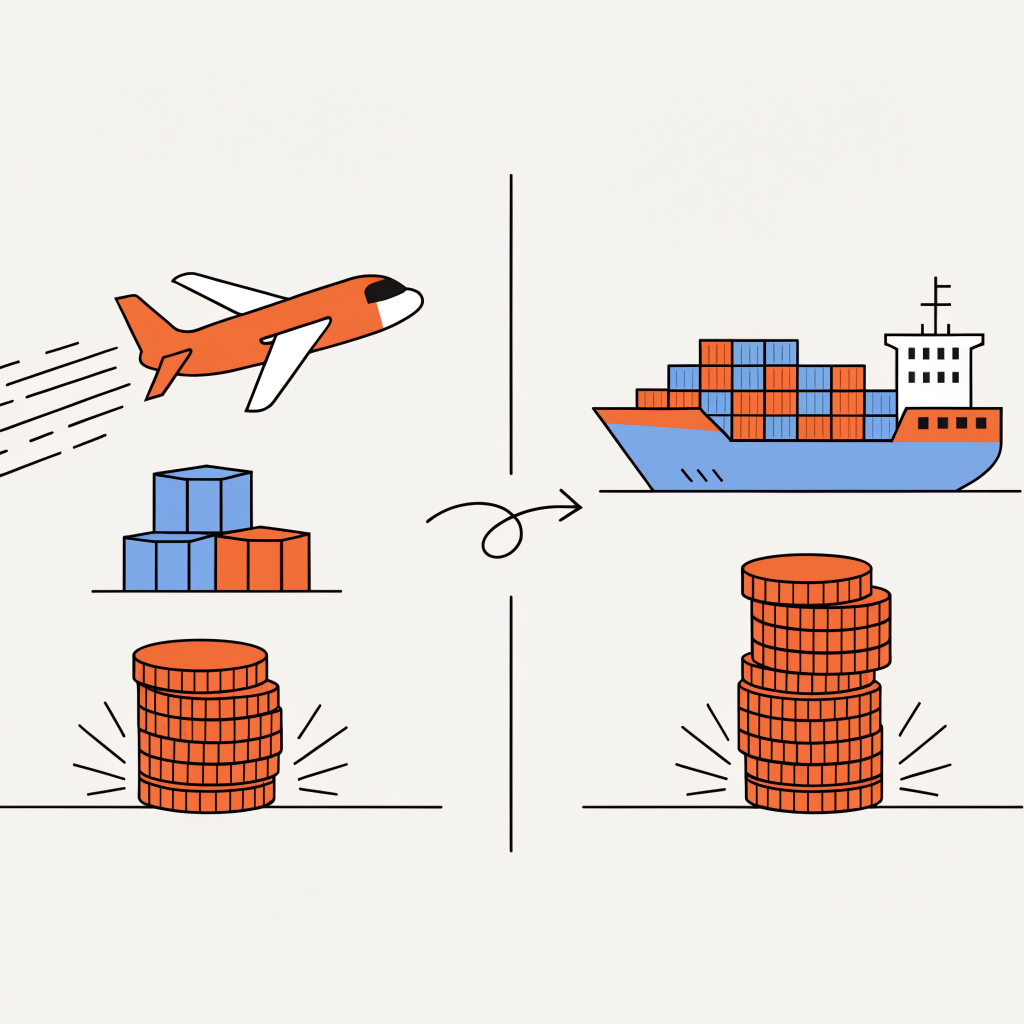
Trade-off: LCL saves ~$1.92/unit but adds ~2–3 weeks lead time.
US and EU/UK compliance watch list
United States
- ISF (10+2) for ocean must be filed ≥24 hours before vessel loading; late/incorrect filings risk $5,000 penalties.
- Customs bond: single-entry or continuous bond required for imports.
- IOR: foreign sellers can be IOR with an EIN; Amazon cannot be IOR.
- Additional tariffs (Section 301) may apply; verify duty impact before you quote DDP.
- FDA/other agencies: check if your SKU is regulated.
EU/UK
- EORI required for customs clearance; importer must be identified and VAT accounted for.
- Product compliance (CE/UKCA, RoHS, WEEE, food contact, cosmetics) as applicable.
- For FBA, register for VAT where inventory is stored; align with postponed VAT accounting5 where available.
Avoid the most common inbound failure points
- Wrong labels or box content mismatch: make the box content feed match the physical pack; audit a sample.
- Oversize or overweight cartons: keep to Amazon maxima; mark heavy boxes.
- Non-appointment delivery attempts: only approved carriers with booked windows will be received.
- Batteries and magnets: declare, package per IATA/IMDG; use compliant materials and paperwork.
- Weak data: vague invoice descriptions trigger exams; use precise HS codes and product descriptions.
- No safety stock: add buffers for peak season (Golden Week, CNY, Q4).
When each method wins
- Express DDP: launches, lightning-fast restocks, low SKU count.
- Air + Truck: planned replenishment with 1–2 week urgency; higher reliability than express during surges.
- Ocean LCL: steady flows where cash and cost are tight; combine SKUs and factories via consolidation.
- FCL: recurring demand with predictable turns; best unit cost and lowest damage risk.
- Rail to EU: faster than sea when air is too costly; check DG and size limits.
Our operating recommendations
- Align on one master carton spec that fits both Amazon rules and your volumetric target (e.g., optimize to avoid dimensional surcharges).
- Standardize labels at origin: FNSKU, carton, and pallet labels applied before cargo leaves the factory.
- Choose a forwarder that files ISF/AMS on time, coordinates Amazon appointments, and can deliver DDP with compliant IOR/EORI.
- Build a replenishment calendar: ETD/ETA buffers, clearance, and appointment lead time benchmarks per FC region.
- Always calculate landed cost per unit before placing the PO; validate against your margin and FBA fee stack.
Summary and next steps
- Pick your mode using weight/volume/urgency thresholds and plan with realistic transit windows.
- Confirm Incoterm and IOR/EORI early; Amazon is not the Importer of Record.
- Lock packaging, labeling, and cartonization to Amazon rules; create shipment plan and box content precisely.
- Book space, file ISF/AMS, and pre-clear with correct HS codes and documents.
- Secure the Amazon appointment and deliver with compliant carriers; reconcile receiving and update your lead times.
Action plan:
- Under 100 kg: express DDP; 100–500 kg: air + truck; 2–12 cbm: LCL; >12–15 cbm: FCL; EU fast lane: rail.
- Create a standard SOP covering document templates, label placement, ISF/AMS timelines, and appointment booking.
- Run landed cost per unit scenarios for at least two modes before finalizing the PO.
People Also Ask
Can Alibaba ship directly to Amazon?
Yes. You can have orders produced by suppliers found on Alibaba shipped directly to Amazon FBA. The key is to meet Amazon’s labeling/packaging rules and to arrange the right trade term: many sellers use FOB with their own forwarder to manage customs and FBA delivery, or DDP where duties and final-mile are prepaid. Ensure the shipment plan, box/pallet labels, and carrier appointment are created in Seller Central before departure.
How does shipping from China to the US work?
You choose a transport mode—express, air, or ocean—then book space, prepare export documents, and file US advance filings (ISF for ocean, AMS for air/ocean). After arrival, your broker clears customs, duties are paid, and a domestic carrier with an appointment delivers to the destination (e.g., an Amazon FC). Typical door-to-door transit: express 3–7 days, standard air 6–10 days, and ocean LCL 18–35 days depending on lane and port congestion.
How to ship to Amazon from China?
- Create your Amazon shipment plan (choose SPD/LTL/FTL) and download box/pallet labels.
- Prepare units with FNSKU labels and compliant cartons/pallets.
- Select a forwarder and Incoterm (FOB/DAP/DDP), and book the main leg.
- File required customs entries (ISF/AMS), clear at destination, and pay duties/taxes.
- Have an approved carrier book an appointment and deliver to the assigned FC.
-
Incoterm: Read to understand how trade terms allocate cost, risk, and responsibilities across EXW/FOB/DAP/DDP—so you can choose terms that prevent surprise fees and ensure your forwarder can complete FBA delivery and appointments. ↩
-
FNSKU: Read to learn what FNSKU is, how to label units to Amazon standards, and how proper labeling reduces receiving defects, commingling risks, and check-in delays. ↩
-
CFS: Read to grasp how Container Freight Station handling works for LCL—what fees and delays it adds, damage/minimum charge risks, and how to package and plan to mitigate them. ↩
-
Section 301: Read to verify whether your products are subject to US Section 301 tariffs, how to confirm HTS classifications, apply exclusions, and model the duty impact in landed cost. ↩
-
postponed VAT accounting: Read to see how PVA lets you defer VAT cash outlay at import in the UK/EU, eligibility and setup steps, and how to report it correctly to improve cash flow. ↩