Skip to content
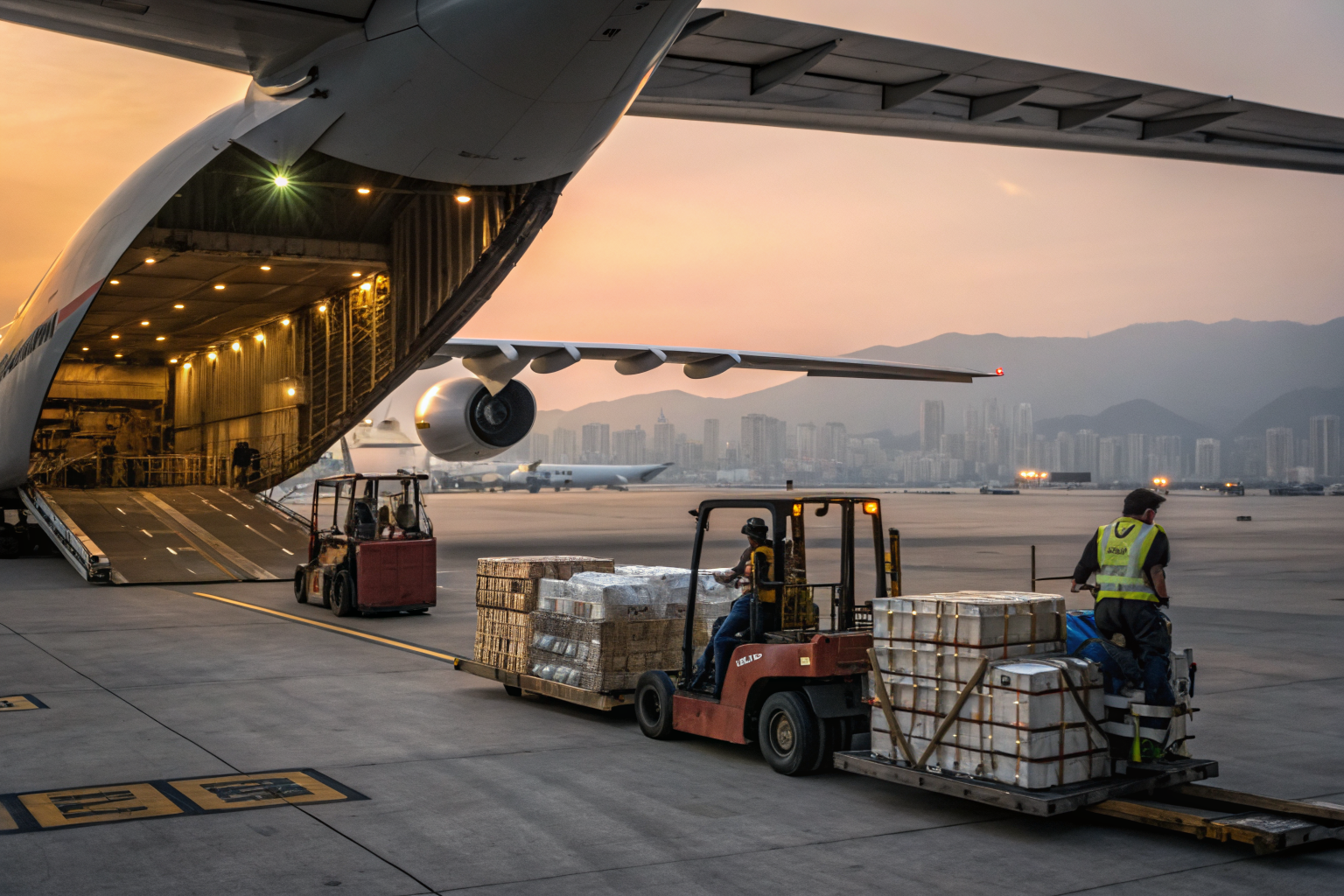
Air freight from China to the USA costs between $4.50–$8.20 per kg in 2026, depending on route, cargo type, and fuel surcharges. Peak season rates (September–November) can spike 25–40% higher, while standard economy air freight averages $5.80/kg for general cargo on major lanes like Shenzhen–Los Angeles.
Here's what most importers miss: air freight pricing has fundamentally decoupled from pre-2020 patterns. The market isn't just volatile—it's structurally different. Understanding these shifts isn't about saving a few cents per kilo; it's about protecting your margins when a single delayed shipment can cost you Amazon Buy Box placement or B2B contract penalties.
How Much Is Air Freight Per KG From China?
Current rates range from $4.50 to $8.20 per kg for standard general cargo, with express and specialized freight commanding premium pricing.
Pricing tiers break down as follows:
| Service Type | Rate per KG (USD) | Transit Time | Best For |
|---|---|---|---|
| Economy Air Freight | $4.50–$5.80 | 7–10 days | Non-urgent B2B inventory, restocking |
| Standard Air Freight | $5.80–$6.90 | 5–7 days | Amazon FBA replenishment, seasonal goods |
| Priority/Express Air | $7.20–$8.20 | 3–5 days | High-value electronics, urgent orders |
| Charter Services | $8.50–$12.00 | 2–3 days | Oversized cargo, capacity shortages |
These rates assume chargeable weight (actual vs. volumetric, whichever is higher) and exclude customs duties, terminal handling, and last-mile delivery. Fuel surcharges currently add 18–24% to base rates, up from 12% in 2023.
Density matters enormously. A 100kg shipment of compact electronics might cost $580. The same weight in bulky packaging foam—occupying 3x the volume—could jump to $1,740 due to dimensional weight pricing at 1:6 ratio.
What Is the Air Freight Market Update in 2026?
The 2026 air freight market is characterized by structural capacity constraints, elevated fuel costs, and demand volatility driven by e-commerce pull-forward and manufacturing diversification beyond China.
Three forces reshaping rates:
- Belly capacity remains tight: International passenger flights to the US from China are still 22% below 2019 levels. Dedicated freighter capacity absorbed some demand, but new aircraft deliveries lag—Boeing 777F and Airbus A350F backlogs extend to 2027.
- Fuel cost persistence: Sustainable aviation fuel mandates and jet fuel price volatility added $0.80–$1.20/kg to shipping costs compared to 2019 baselines. Carriers pass through 85–95% of fuel fluctuations via surcharges.
- China+1 manufacturing shifts: While Vietnam, India, and Mexico gain share, China still produces 28% of global manufactured exports. This creates bifurcated routing complexity—importers now manage multi-origin air freight networks rather than single-corridor optimization.
Seasonality has intensified. Q4 2025 saw rates spike 34% on the Shenzhen–LAX corridor. King-Hor's data across 1,000+ client shipments shows 2026 rate volatility (coefficient of variation: 18%) exceeds 2019 levels by 7 percentage points.
Why Smart Importers Are Locking in Hybrid Strategies
The shift: air freight is no longer a binary choice between speed and cost. Leading importers now deploy dynamic mode allocation—air for velocity-sensitive SKUs, ocean for predictable demand, with seamless switching triggers.
Implications for your business:
- Inventory carrying costs vs. freight costs: At $6.50/kg air freight, the break-even against 30-day ocean freight ($1,800/40' container equivalent) occurs when stockout costs exceed 12% of product value. For Amazon sellers with IPI score penalties, this threshold drops to 8%.
- Lead time compression as competitive weapon: B2B customers increasingly expect 2-week delivery windows that ocean freight cannot meet. Air freight becomes a customer retention tool, not just logistics expense.
- Carbon accounting pressure: Scope 3 emissions reporting affects enterprise procurement decisions. Air freight generates 47x CO2 per ton-mile vs. ocean—importers need transparent mode data for ESG compliance.
What to do differently:
- Negotiate annual rate agreements with flex capacity: Fixed-volume contracts secure base rates; flex clauses (±30%) accommodate demand spikes without spot market exposure.
- Implement freight visibility dashboards: Real-time tracking across air and ocean modes enables proactive customer communication and inventory repositioning.
- Diversify origin gateways: Shanghai Pudong (PVG) congestion pushed 23% of King-Hor's 2025 air freight through Shenzhen (SZX), Hong Kong (HKG), and Zhengzhou (CGO). Multi-airport strategies reduce single-point failure risk.
King-Hor's Integrated Approach: Air, Ocean, and Everything Between
Since 2015, King-Hor Supply Chain has moved cargo for 1,000+ clients across China-to-USA corridors. Our Shenzhen, Los Angeles, and Hong Kong offices coordinate:
- Air freight: Economy through express tiers, with 5–7 day standard transit to LAX/ORD/JFK
- Ocean freight: FCL/LCL with 14–18 day expedited ocean options vs. 25–32 days standard
- FBA door-to-door: Pickup in China, customs clearance, direct injection to Amazon FCs
- Customs clearance: ISF, entry, HTS classification, duty drawback recovery
- LA warehousing: Transloading, labeling, palletization, and B2B fulfillment from our Compton facility
Our advantage isn't single-mode expertise—it's seamless handoffs. A shipment can pivot from ocean to air mid-transit if demand signals shift. Customs clearance begins while cargo is still airborne. Warehouse inventory feeds both Amazon replenishment and wholesale B2B orders.
Calculate Your True Landed Cost
Per-kg rates tell only part of the story. Hidden costs—demurrage, detention, customs delays, stockouts—often exceed freight spend. King-Hor provides landed cost modeling that incorporates:
- Actual chargeable weight calculations
- Duty and tariff engineering
- Inventory carrying cost by transit mode
- Stockout probability and revenue impact
Get your free, no-obligation quote today. Our team analyzes your product mix, demand patterns, and risk tolerance to recommend the optimal China-to-USA shipping strategy—whether that's locked-in air freight rates, hybrid ocean-air programs, or seasonal capacity reservations.
Request your free quote → | Shenzhen: +86-755-XXXX-XXXX | Los Angeles: +1-323-XXXX-XXXX