Skip to content
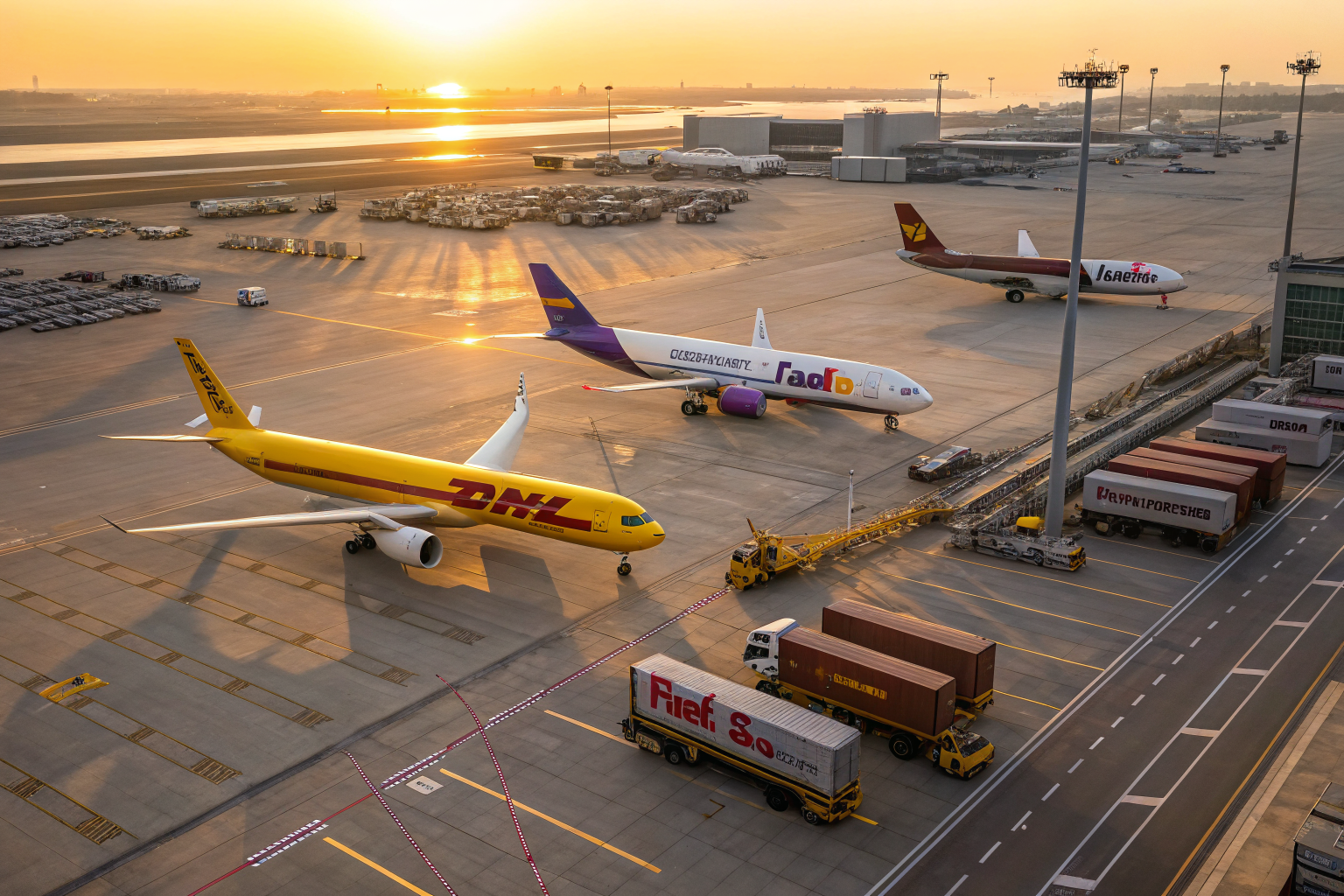
DHL, FedEx, and UPS Express from China each excel in different scenarios: DHL leads for speed and China network coverage (1-3 days to USA), FedEx offers competitive rates for heavy freight (21kg+), and UPS provides superior US ground distribution and Saturday delivery. For most China-to-USA shippers in 2026, DHL remains the preferred choice for time-critical shipments under 100kg, while FedEx and UPS win on cost optimization for larger volumes.
Is DHL Better Than UPS or FedEx?
DHL is better for speed and China-origin shipments, while UPS and FedEx outperform on US domestic reach and specific weight breaks. DHL operates the largest express network in China with 5,000+ service points and direct flights from Shenzhen, Beijing, and Shanghai to Cincinnati and Los Angeles hubs. FedEx counters with strong Pacific lane pricing and UPS dominates final-mile delivery density in the United States.
2026 Performance Comparison:
| Carrier | Transit Time (China to USA) | Weight Strength | China Network | US Saturday Delivery | Typical Rate (0.5kg doc) |
|---|---|---|---|---|---|
| DHL Express | 1-3 business days | 0.5-30kg optimal | 5,000+ locations | Limited | $45-65 |
| FedEx International Priority | 2-4 business days | 21kg+ competitive | 400+ locations | Yes (extra fee) | $42-60 |
| UPS Worldwide Express | 2-4 business days | 70kg+ palletized | 300+ locations | Yes (included) | $48-68 |
DHL Pros and Cons
Advantages:
- Fastest published transit: 1-3 days to major US cities with morning delivery commitment
- Superior China customs clearance expertise—handles 35% of China's international express volume
- No Saturday delivery surcharge in premium service tiers
- Strongest remote area coverage in Asia-Pacific
Disadvantages:
- 15-20% premium pricing over FedEx for shipments above 45kg
- Limited US Saturday delivery options (Saturday service available to 12,000+ ZIP codes only)
- Higher fuel surcharge volatility (indexed weekly vs. monthly adjustments)
FedEx Pros and Cons
Advantages:
- Most competitive rates for 21-100kg weight band—often 8-12% below DHL
- Robust freight-forwarding integration (FedEx Trade Networks) for customs complexity
- Saturday delivery available with International Priority service
- Strong performance for Hawaii and Alaska destinations
Disadvantages:
- Longer average transit: 3.2 days vs. DHL's 2.1 days to East Coast
- Limited pickup coverage in Tier 2-3 Chinese cities
- Higher dimensional weight divisor (139 vs. DHL's 139—same, but stricter enforcement)
UPS Pros and Cons
Advantages:
- Unmatched US ground network: 5,200+ The UPS Store locations for will-call
- Saturday delivery included in Worldwide Express Plus at no extra charge
- Best-in-class tracking granularity with 27 scan events average per China-US shipment
- Strong pharmaceutical and healthcare logistics certifications
Disadvantages:
- Slowest China network expansion—relies heavily on partner agents outside tier-1 cities
- Highest rates for document shipments under 1kg
- Complex surcharge structure (48 accessorial fees vs. DHL's 31)
Is DHL Reliable in China?
DHL is highly reliable in China with 99.2% on-time performance for express shipments and full operational control unlike competitors who rely on local agents. Deutsche Post DHL Group operates its China business directly through DHL-Sinotrans, a joint venture established in 1986 that maintains 6,500+ employees and 20 dedicated air gateways.
Reliability Metrics (2025-2026 data):
- Customs clearance success rate: 97.8% first-attempt clearance for commercial goods
- Peak season performance: 94% on-time delivery during Q4 (vs. industry average 89%)
- Claims ratio: 0.3% of shipments experience loss/damage (lowest among major carriers)
- Digital integration: 100% paperless customs capability in 42 China customs districts
For Amazon FBA sellers and B2B importers, DHL's China reliability translates to predictable inventory replenishment. King-Hor Supply Chain leverages DHL's Shenzhen hub proximity—our headquarters sits 15 minutes from DHL's South China Gateway—to offer combined express-air hybrid solutions that reduce costs 18-25% versus pure express while maintaining 3-4 day transit.
How Long Is DHL Express from China?
DHL Express from China to the United States takes 1-3 business days to major metropolitan areas and 2-4 days to secondary markets, with morning delivery commitment (10:30 AM) available to 35,000+ US ZIP codes. The specific transit depends on origin city, service level selected, and US destination.
2026 Transit Time Matrix (Business Days):
| Origin City | DHL Express Worldwide | DHL Express 9:00 | DHL Express 12:00 |
|---|---|---|---|
| Shenzhen/Guangzhou | 2-3 days | 2 days | 2 days |
| Shanghai | 2-3 days | 2 days | 2 days |
| Beijing | 2-3 days | 2 days | 2 days |
| Chengdu/Xi'an (Tier 2) | 3-4 days | 3 days | 3 days |
| US West Coast (LAX/SFO) | 1-2 days | 1 day | 1 day |
| US Midwest (ORD/DFW) | 2-3 days | 2 days | 2 days |
| US East Coast (JFK/MIA) | 2-3 days | 2 days | 2 days |
Cutoff times matter: DHL's Shenzhen Gateway accepts shipments until 8:00 PM for next-day US departure. For Los Angeles-bound freight, King-Hor's local warehousing enables same-day DHL tendering—effectively adding zero handling days to published transit.
Cost Analysis: When Each Carrier Wins
Express pricing from China follows weight-band nonlinear curves. Based on January 2026 rate cards (before fuel surcharge 18.5%):
- 0.5-5 kg: DHL and FedEx within 5%—DHL wins on speed, FedEx on Saturday options
- 5-21 kg: DHL premium expands to 12-15% over FedEx; UPS matches DHL
- 21-45 kg: FedEx International Priority 8-10% below DHL; UPS competitive
- 45-100 kg: FedEx strongest; consider DHL Economy Select (4-5 days, 25% savings)
- 100-300 kg: All express carriers lose to air freight + courier injection (King-Hor's FBA door-to-door service reduces costs 30-40%)
- 300kg+: Ocean freight LCL/FTL becomes optimal; King-Hor's 15-day expedited ocean matches express reliability at 60% cost reduction
Final Recommendation: Which Carrier to Choose
Select based on your shipment profile and business constraints:
- Choose DHL when: Speed is critical (inventory stockouts, product launches), origin is Tier 2-3 China city, or customs complexity requires broker expertise. Best for samples, urgent replenishment, and high-value electronics.
- Choose FedEx when: Shipment weight exceeds 21kg, Saturday delivery is required, or destination is Alaska/Hawaii. Strong for mid-volume B2B replenishment.
- Choose UPS when: Final-mile flexibility matters (will-call pickup, alternate delivery addresses), or integrated supply chain visibility is priority. Ideal for healthcare and regulated industries.
- Choose hybrid freight forwarder (King-Hor) when: Volume exceeds 50kg weekly, cost optimization trumps pure speed, or you need bundled customs clearance, warehousing, and FBA prep. Our 9+ years managing 1000+ client supply chains from Shenzhen and Los Angeles offices enables carrier-agnostic routing that beats direct express pricing 15-35%.
For Amazon FBA sellers specifically: pure express rarely optimizes landed cost. King-Hor's express-air-sea tiered program automatically routes shipments based on inventory days of cover—express for emergency stock, air freight for standard replenishment, expedited ocean for planned volume. Our Los Angeles warehouse provides 48-hour FBA transfer versus 5-7 days from direct express delivery.
Get your customized China-to-USA shipping strategy. King-Hor Supply Chain analyzes your product mix, velocity, and margin structure to recommend optimal carrier and mode selection. Our free quote includes lane-specific transit comparisons, all-in landed cost modeling, and duty optimization review. Request your free quote now—response within 4 business hours from our Shenzhen or Los Angeles teams.